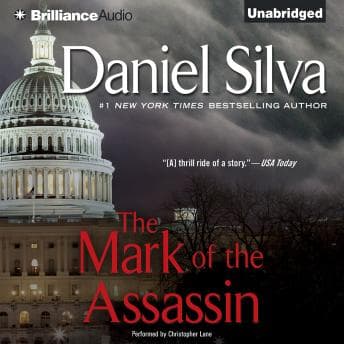

I was shelving returns in the back of the library last Tuesday — the fluorescent light above the mystery section has been flickering for three weeks and nobody's fixed it — when I decided to throw on Mark of the Assassin to kill the monotony. Spy thriller in a half-lit room surrounded by old books? The vibes were accidentally perfect.
Here's the thing about Daniel Silva before Gabriel Allon: he was still figuring out what kind of spy novelist he wanted to be. Mark of the Assassin is from that earlier era, the Michael Osbourne series, and you can feel Silva testing the waters. The bones of what would become his signature style are here — the intelligence community politics, the moral ambiguity, the way personal vendettas bleed into geopolitical operations — but it's rougher. Less polished. Which isn't entirely a bad thing.
The Ghost of a Dead Lover and a Three-Bullet Signature
The premise hooks you fast: a commercial airliner gets blown out of the sky, a body shows up near the wreckage with three bullets to the face, and CIA agent Michael Osbourne recognizes the calling card because he's seen it before — on someone he loved. That's a hell of a setup. Silva understands that the most effective thrillers aren't about the world ending. They're about one person's obsession becoming the lens through which we see everything else. Osbourne's fixation on this assassin isn't just professional. It's grief and rage wearing a badge.
And look — I know this is technically a thriller, not horror, but the way Silva builds the assassin as this almost spectral presence, someone who exists in the negative space of the story more than the foreground? That's dread. Shirley Jackson walked so... okay, maybe that's a stretch. But the principle holds. The unseen threat is always scarier than the visible one.
The plot itself is solid mid-90s espionage fare. You get your Washington power plays, your shadowy European connections, your protagonist going rogue against agency orders. Vendetta scratches that same itch — personal score to settle, institutional obstruction, the whole dance. It doesn't reinvent the wheel, but it spins it well enough. At 11 and a half hours, it earns its runtime without too much bloat, though there are stretches in the middle — particularly the political maneuvering scenes — where the momentum dips before the personal stakes yank it back.
Christopher Lane: Award-Winning, But Make It Divisive
Okay. Christopher Lane. This is where I have to be honest, and honesty here is complicated.
Lane is an award-winning narrator. Multiple Audies. AudioFile Earphones Awards. The man has credentials. And his baseline narration — the connective tissue between dialogue, the pacing of exposition, the way he handles Osbourne's internal monologue — is genuinely good. He reads like someone who's done the homework. He knows when to push and when to pull back.
But the character voices. Some of them are... choices.
His female characters land in this register that feels like he's performing femininity rather than inhabiting it. The assassin — who should be cold, dangerous, terrifying — comes across as breathy in a way that undercuts her menace. And there's this one character (I won't spoil who) where Lane goes full mid-Atlantic aristocrat and it sounds like someone doing a community theater impression of a British villain. I actually pulled out an earbud during one exchange because the tonal shift was so jarring it broke immersion completely.
Here's the frustrating part: when Lane commits to the thriller energy — the tense, clipped conversations between intelligence officers, the quiet dread of Osbourne realizing he's in over his head — he's excellent. The narrator commits. That's rare. But then he'll pivot to a voice that belongs in a different audiobook entirely, and you're yanked right out.
I landed on calling it uneven. Not bad. Uneven. There's a difference.
Who Gets the Most Out of This
If you're a Silva completist working backward from the Allon series, this is essential context — you can feel him building toward what he'd eventually master. And if the vendetta-as-engine structure is what's drawing you in, Lover Arisen takes that same emotional core somewhere wilder — different universe entirely, but the obsession driving the plot hits the same nerve. If you're new to Silva, this probably isn't where I'd start, but it's not a bad entry point either.
If you scare easily — wrong genre, wrong reviewer, wrong podcast. But if you like your thrillers with a personal vendetta at the center and you can tolerate some narrator quirks that range from inspired to baffling, there's enough here to justify the listen.
Skip if: you need consistent narrator voices to stay locked in, or if post-Cold War espionage politics make your eyes glaze.
The Flickering Light Test
I finished the last hour at home, in the dark (because of course I did), with Shirley curled on my chest doing her best impression of not caring. The ending delivers — Silva knows how to close a book with weight. The journey there is bumpy in spots, both on the page and in the performance, but the destination earns its keep.
My podcast listeners are going to love arguing about this one. The Lane discourse alone could fuel a whole episode.