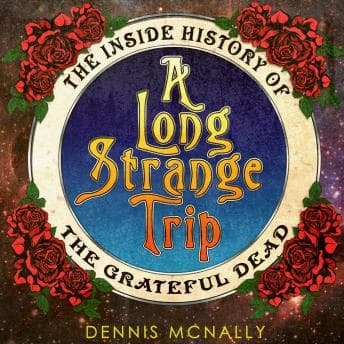

"The Grateful Dead were not in the music business. They were in the Grateful Dead business."
That line hit me somewhere around hour twelve, and I had to pause my design work because—yeah. That's it. That's the whole thing. This isn't a band biography. It's a love letter to beautiful chaos, written by someone who lived inside it.
Okay, so here's where I confess something: I'm not a Deadhead. Never was. My abuela's house was all Vicente Fernández and Los Tigres del Norte, not "Truckin'." But my ex-boyfriend was obsessed—had the dancing bears tattooed on his shoulder blade, the whole thing—and I always wondered what the fuss was about. Twenty-nine hours later? I get it. I finally get it.
When History Becomes Feeling
Dennis McNally doesn't just chronicle dates and album releases. He makes you feel what it was like to be in the Haight in 1967, to watch Jerry Garcia's fingers find something transcendent on a random Tuesday night, to understand why people followed this band across decades and state lines like it was a religious calling. Because for a lot of them, it was.
The structure threw me at first—it jumps around in time, which can be disorienting. I'd be deep in the seventies drug haze and suddenly we're back in Palo Alto watching teenagers discover folk music. But honestly? Once I stopped fighting it and just let the narrative wash over me the way you'd let a jam session unfold, it started making sense. This isn't a Wikipedia entry. It's a vibe. The Alchemist had that same dreamlike quality where the journey matters more than the destination. The non-linear thing mirrors how memory actually works, how the Dead themselves approached their music—improvised, circling back, finding new meaning in old themes.
I ugly-cried at the Pigpen sections. Didn't expect that. Here's this guy, Ron McKernan, who was the soul of the early band, this blues-obsessed kid who couldn't quite keep up with the psychedelic evolution happening around him. Watching his story unfold knowing where it ends—my heart. MY HEART. McNally doesn't sensationalize his death, just presents it with this quiet devastation that hit harder than any dramatic treatment could have.
Sean Runnette's Steady Hand
Look, some reviews mention the narration being monotone, and I can see how someone might feel that way if they're expecting theatrical delivery. But here's the thing—this book is almost thirty hours long. If Runnette had gone full dramatic actor on every paragraph, it would be exhausting. Instead, he gives you this steady, warm presence. Like a really good storyteller at a party who doesn't need to perform because the story is doing the work.
His pacing is genuinely excellent. The man knows when to let a moment breathe and when to push forward. There's this section about the Acid Tests that could have been chaos to follow, but Runnette keeps you grounded even when the content is absolutely unhinged. (And it gets unhinged. Ken Kesey and the Merry Pranksters make their appearances and things get WILD.)
If you need distinct character voices, this isn't that kind of narration. It's more documentary than dramatization. But for a dense historical biography? It works. It really works.
The Jerry Problem (And Why It's Actually Fine)
Yeah, this book centers Jerry Garcia pretty heavily. Some listeners complain about that, and fair enough—Bob Weir and Phil Lesh and the drummers deserve their own biographies. But Garcia was the gravitational center of the Dead whether anyone wanted him to be or not. McNally doesn't shy away from the complicated parts either: the heroin addiction, the way Jerry's health deteriorated while the machine kept demanding more tours, more shows, more of everything he had left to give.
The last few hours of this audiobook are genuinely hard to listen to. Not because of the narration—because you know what's coming, and McNally builds this slow, inevitable tragedy that I wasn't prepared for. I was finishing up a logo design for a coffee shop and suddenly I'm crying over a man I never met who died before I was old enough to appreciate his music.
Abuela would have been confused by this one, honestly. But she would have understood the devotion. The way people build their whole lives around something beautiful and strange. She did that with her saints and her telenovelas. The Deadheads did it with their band.
Who's This For?
If you're a Deadhead, this is essential—you already know that. If you're curious about the sixties counterculture, this is one of the most immersive ways in. But if you need everything chronological and tidy, maybe read the physical book instead where you can flip back and forth. Skip this if you want a quick music bio or can't commit to the thirty-hour runtime.
Would I listen to all thirty hours again? Let's be real—probably not. But certain sections? Absolutely. The early San Francisco stuff. The Wall of Sound chapters. The Pigpen material. This is the kind of audiobook you can dip back into, let it play while you're working on something that doesn't require your full brain.
Corazón, This One Stays With You
If you've got a long commute or a job that lets you listen for hours—this is a journey worth taking. Even if, like me, you started it as an outsider.


![Steve Jobs [unabridged audiobook] audiobook cover](/_next/image?url=https%3A%2F%2Fcovers.audiobooks.com%2Fimages%2Fcovers%2Ffull%2F9788499923406.jpg&w=1920&q=75)