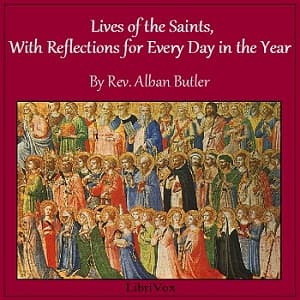

Denise and I have this Sunday morning routine. Coffee, the lakefront, and whatever I've got queued up. She does her thing with a true crime podcast, I do mine. Last month I started Butler's Lives of the Saints on one of those walks, and honestly? I didn't expect it to become the thing I kept returning to on Tuesday nights at 11 PM while red-penning sophomore essays on The Great Gatsby. But here we are.
Let me give you some context first, because this book needs it.
An 18th-Century Priest Wrote the Wikipedia of Sainthood
Alban Butler was an English Catholic missionary priest living in France - already a fascinating biographical detail, given that being openly Catholic in 18th-century England was roughly as comfortable as teaching Faulkner to sixteen-year-olds. Between 1756 and 1759, he published a massive twelve-volume collection of saint biographies. Twelve volumes. The man was committed. This audiobook is the condensed version: one saint per day, 365 entries, each followed by a short moral reflection. Think of it as the greatest hits album of Catholic hagiography.
And that structure is both its genius and its limitation. Each entry runs maybe two to three minutes. You get the saint's name, their historical moment, the manner of their martyrdom or notable virtue, and then Butler pivots into a reflection that reads like a very earnest homily. It's repetitive by design - this was meant to be read one day at a time, not consumed in a fourteen-hour stretch. But I'm a man who once listened to all of Middlemarch during faculty meetings, so moderation isn't really my strong suit.
What Butler Is Really Saying Between the Martyrdoms
Here's what struck me as an English teacher, not a theologian: Butler's prose has this fascinating 18th-century formality that occasionally cracks open into something genuinely moving. His entry on St. Lawrence, for instance - the Roman deacon who was reportedly roasted alive on a gridiron and supposedly told his executioners to turn him over because he was "done on this side" - Butler doesn't play that moment for drama. He treats it with this measured, almost clinical calm that makes the horror land harder. The restraint IS the interpretation. This reminds me of what Hemingway said about the dignity of movement of an iceberg - what's unsaid carries the weight.
But then you'll hit a stretch in, say, the August or September entries where you get five consecutive virgin martyrs from the early Church and the biographical details start blurring together. Persecution, refusal to sacrifice to Roman gods, gruesome death, heavenly reward. The pattern becomes almost liturgical in its repetition, which - fair enough, that's kind of the point. Butler wasn't writing literary criticism. He was writing devotional material.
The reflections after each biography are where Butler gets preachy in the most literal sense, and your mileage will vary wildly. Some land with genuine moral force. Others read like the 18th-century equivalent of a motivational poster. My students would hate this. I love it. (Well. Most of it.)
Maria Therese Reads Like She Means It
This is a LibriVox recording, which means it's volunteer-produced and free, and you should calibrate your expectations accordingly. But Maria Therese - and I want to be specific here - brings a steady, reverent tone that serves this material exactly right. She doesn't perform these entries. She presents them. There's a difference, and it matters.
Her pacing is measured, almost meditative. No dramatic vocal shifts, no attempt to "do voices" for saints and emperors (which would've been absurd for this format). What she does well is maintain a consistent warmth across fourteen hours of material that could easily become monotonous in less careful hands. The narrator understands that pause is punctuation - and in devotional reading, that's everything.
Is it professional studio quality? No. You'll hear the occasional room-tone shift, the slight variance in recording levels that comes with a project recorded over many sessions. But nothing that pulled me out of the listening experience. For a free recording of an 18th-century religious text, this is genuinely solid work.
Who This Is For (And Who Should Keep Walking)
If you're Catholic or have any serious interest in Church history, this is a quiet treasure. It's not scholarship - Butler takes hagiographic traditions at face value, miracles and all - but as a survey of how the Catholic Church constructed its calendar of sanctity, it's surprisingly rich. If you loved reading about medieval religious life in something like Umberto Eco's The Name of the Rose, this is its spiritual ancestor. Literally. And if you want to stay in this territory but hear Scripture itself rendered with genuine dramatic weight, I spent a week with James Earl Jones Reads the Bible: The King James Version of the New Testament last year - a completely different approach to sacred text, one narrator doing in his voice what Butler tried to do across twelve volumes.
If you're looking for narrative drive, character arcs, or anything resembling a plot - wrong book. This is a reference work read aloud. It's best consumed the way Butler intended: a few minutes a day, not in marathon sessions. I learned that the hard way around hour nine.
The prose deserves to be savored in small portions. Like communion wafers, not a buffet. Colm Tóibín takes that same demand for slowness and turns it inside out in Testament of Mary - one woman's version of the story, stripped down to almost nothing, and somehow it hits harder than anything Butler puts in twelve volumes.
The Lesson Plan
I'm not going to pretend this changed my life. But listening to Butler describe century after century of people who chose suffering over compromise - while I sat there complaining about essay margins - did put a few things in perspective. It's a strange, repetitive, occasionally beautiful artifact from a world that took holiness as seriously as we take algorithms. Worth your time if you come to it with the right expectations and the patience of, well, a saint.