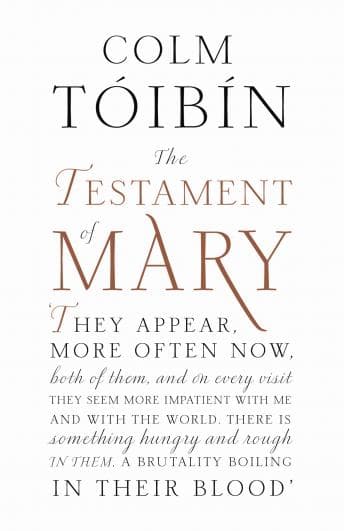

I have a complaint. Twenty years teaching high school English, and nobody warned me that Meryl Streep would make me cry during a faculty budget meeting.
There I was, Principal Martinez droning about textbook allocations, earbuds hidden under my collar, and Streep's Mary is describing how she fled the crucifixion to save herself. The guilt in that woman's voice—not theatrical guilt, but the quiet, corrosive kind that eats at you for decades. I had to pretend I was moved by the proposed cuts to the drama department.
The Gospel According to a Mother Who Watched Her Son Die
This is not the Mary you grew up with. Forget the serene figure in blue robes, hands folded, eyes cast heavenward. Tóibín gives us an elderly woman living alone in Ephesus, bitter and sharp-tongued, dismissing the disciples as "misfits who could not look a woman in the eye." She doesn't believe her son was divine. She believes he was her son, and that he died badly, and that she ran away before it was over.
The prose deserves to be savored. Tóibín writes in these long, winding sentences that feel almost liturgical—which is ironic, given that Mary spends most of the book rejecting the liturgy being built around her. Streep handles the rhythm beautifully. She understands that pause is punctuation. When Mary describes the wedding at Cana, there's this moment where she hesitates before the word "miracle," and you can hear her deciding whether she even believes it happened the way people say.
At three hours, this is practically a novella. But don't let the brevity fool you. This is dense, emotionally demanding material. I listened at 1.0x because the author chose those words, and Streep chose exactly how to deliver them. Speeding up would be like fast-forwarding through Antigone's final monologue.
Streep's Performance—And Why Some Listeners Hate It
Let me be honest: some people find Streep's narration overwrought. I've seen reviews calling it "hammy" or comparing her to "a telenovela actress on meth." And I get it—she makes choices. Big choices. There are moments where her emphasis on certain words feels almost aggressive.
But here's the thing. This is a woman who watched her son tortured to death and then spent the rest of her life being told it was beautiful, it was necessary, it was God's plan. Of course she's dramatic. Of course she's bitter. Streep isn't performing serenity because Mary isn't serene. She's performing decades of suppressed rage and grief.
The weariness in her voice during the later sections—that's not acting, that's channeling. When Mary talks about the men who keep visiting her, asking her to confirm their version of events, you can hear her exhaustion. These aren't the Gospel writers she's dealing with. They're spin doctors. And she knows it.
What Tóibín Is Really Saying
If you loved Antigone—the original, not the watered-down versions—this is its spiritual successor. White Ivy explores that same trap from a different angle—a woman trying to write her own story while everyone else keeps editing the margins. Both are about women caught in narratives they didn't choose, forced to watch men construct meaning from their suffering. Mary's testimony is being curated, edited, shaped into something useful. She knows she'll be remembered as the Madonna, silent and accepting. This book is her refusal.
My students would hate this. Too slow, they'd say. Nothing happens. But everything happens. The whole weight of Western religious history gets reframed through one mother's grief. That's not nothing.
The crucifixion scene—or rather, Mary's memory of it—hit me harder than any depiction I've encountered. She doesn't describe it with reverence. She describes the sounds, the smell, the way she couldn't look anymore. And then she admits she left. She ran. She saved herself while her son was still dying. The self-judgment is ruthless, and Streep delivers it without asking for absolution. That refusal to seek comfort reminded me of Nietzsche's approach in Beyond Good and Evil—both texts strip away the consoling lies we tell ourselves about morality and meaning.
Who This Will Break Open (And Who Should Skip It)
This is for readers who want their faith challenged, not confirmed. If you're looking for devotional material, this will make you angry. If you're interested in how grief reshapes memory, how history gets written by the survivors, how mothers carry impossible burdens—this will wreck you. Skip it if you need your religious figures uncomplicated, or if slow, meditative prose makes you restless.
Don't listen while multitasking. Don't listen at the gym. This requires your full attention and probably a dark room afterward.
Class Dismissed
I finished this walking the lakefront with Denise, and I couldn't speak for about ten minutes. She thought I was having a stroke. I was just thinking about Mary, alone in Ephesus, knowing that everything they'd write about her would be wrong.
Three hours. Meryl Streep. A mother who refuses to be comforted. This is why we still read the classics—and why sometimes the best new work feels ancient.