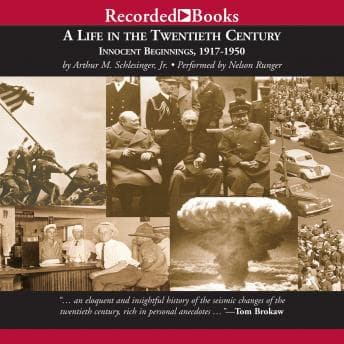

Twenty-eight hours. That's how long this audiobook runs. I want you to sit with that number for a second, because I started this thing during a particularly brutal stretch of junior essay grading — the kind where you've read the phrase "Gatsby represents the American Dream" forty-seven times and your left eye starts twitching — and I didn't finish it until well into the following week. Schlesinger's memoir is not a quick listen. It is, however, the kind of book that made me forget I was grading at all, which is both a compliment to the author and an apology to my third-period class for the generous B-minuses they received.
Here's my complaint, though, and I say this with genuine affection: Schlesinger name-drops like a man who knows exactly how impressive his Rolodex is. And look, when your Rolodex actually includes Reinhold Niebuhr, the Kennedys, and half the Harvard faculty circa 1940, you've earned it. But there are stretches — particularly through his Cambridge years — where the memoir reads less like personal reflection and more like an annotated guest list. He'll mention sitting next to someone at dinner, deliver a wry one-liner about their politics, and move on before you've fully registered who they were or why it matters. For a historian of his caliber, he sometimes trusts the reader to do homework he should've done for us.
The Historian Who Can't Stop Being a Historian
What makes this memoir genuinely special — and different from the dozen other mid-century intellectual memoirs gathering dust on university shelves — is that Schlesinger can't turn off his analytical brain even when he's writing about himself. His Midwestern childhood sections aren't just nostalgia. He's contextualizing his own family within the broader progressive tradition, tracing how his father's academic work shaped his political instincts before he was old enough to have any. The chapter on his time at Exeter and then Harvard isn't "I went to fancy schools" — it's an argument about how institutions manufacture a particular kind of American liberal. He's dissecting himself the way he'd dissect the Age of Jackson. (Which, not coincidentally, won him his first Pulitzer at twenty-eight. Twenty-eight. I was still trying to figure out grad school applications at twenty-eight.)
The World War II sections are where the memoir finds its emotional center. Schlesinger's OSS work and his observations of postwar Europe have that quality I always tell my students to look for — the writer who was there, who saw the thing, and who waited decades to process what it meant. There's a specificity to his descriptions of London during the Blitz and the intellectual scramble of wartime Washington that you simply cannot get from secondary sources. This is why we still read the classics — and this is why primary accounts from people this perceptive have an irreplaceable weight.
Nelson Runger and the Art of the Measured Read
Runger's narration is — and I'm being precise here — exactly right for this material. Not electric. Not dramatic. Right. He reads Schlesinger the way Schlesinger wrote: with a kind of dry, professorial wit that lets the intelligence do the work. The prose deserves to be savored, and Runger understands that pause is punctuation. He doesn't rush through the political analysis to get to the anecdotes, and he doesn't oversell the humor. When Schlesinger is being wry about, say, the absurdities of academic politics, Runger delivers it with just enough lift that you catch the joke without being hit over the head.
Is it a performance that'll keep you riveted during a 5K? No. This is a sit-down-and-pay-attention narration for a sit-down-and-pay-attention book. I listened mostly during late-night grading sessions and a couple of long Saturday lakefront walks with Denise, who at one point asked me why I was smiling at my phone. I was smiling because Schlesinger had just described some forgotten cocktail party intellectual feud with the cadence of a man who'd been waiting fifty years to settle the score. Runger landed the timing perfectly.
Who This Is Really For (and Who Should Run)
If you loved Robert Caro's memoirs about the research life, or if you've ever found yourself genuinely excited by a well-constructed footnote, this is your book. If you're a student of American liberalism, the New Deal era, or midcentury intellectual history, it's pretty much essential listening. My students would hate this. I love it.
But if you need narrative momentum — if you want a memoir that moves like a novel — this will test your patience. Twenty-eight hours of a brilliant man thinking carefully about his own life is a gift, but it's a gift that demands something from you. Worth pausing the faculty meeting for? Absolutely. Worth powering through if you don't care about the ideological formation of postwar American liberalism? Probably not. Though I'll admit, after twenty-eight hours of dense intellectual history, I did briefly consider whether my next listen should be something with absolutely zero ideological stakes — and then I read my own review of Amy's Forbidden Fantasy, which, let's just say, delivered on that front in ways Schlesinger never attempted.
This is the kind of book that makes me grateful audiobooks exist, because I genuinely would not have had the eyesight or the uninterrupted hours to read it in print. But I heard every word at 1.0x, because the author chose those words, and Arthur Schlesinger Jr. chose his very, very carefully.