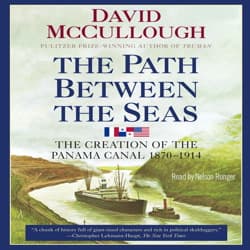

Thirty-one hours is a serious commitment. That's longer than some combat deployments feel—and I say that as someone who's spent real time in theater waiting for something to happen.
But here's the thing: McCullough earned every minute of my time with this one.
The Greatest Engineering Battle You Never Studied
Let me cut to the chase—this is military history disguised as engineering history. The French campaign to build the Panama Canal reads like a textbook case of mission failure: inadequate intelligence, poor logistics, leadership that ignored ground-level reality, and a body count that would make any commander sick. McCullough doesn't sugarcoat it. Twenty thousand dead, mostly from yellow fever and malaria, before the French finally admitted defeat.
Then the Americans show up, and it becomes a different kind of war story. Colonel William Gorgas fighting mosquitoes with the same tactical precision I've seen applied to insurgents. Chief Engineer John Stevens treating the whole operation like a military campaign—because that's essentially what it was. The descriptions of the Culebra Cut excavation, moving more earth than any construction project in human history, reminded me of watching combat engineers work miracles in impossible conditions.
I listened to most of this during windshield time between client sites around Austin. Ranger in the back seat, Texas Hill Country rolling by, and McCullough walking me through the political machinations that separated Panama from Colombia. (Linda caught me gesturing at the steering wheel during a particularly infuriating section about Teddy Roosevelt's maneuvering. She thought I was losing it.)
Runger's Steady Hand on the Throttle
Nelson Runger's narration requires a tactical adjustment. At standard speed, he moves like a convoy in heavy traffic—methodical, safe, and maddening if you're trying to cover ground. Bump it to 1.25x and suddenly you've got a narrator who matches the material's natural urgency.
Once I made that adjustment, his performance clicked. The man handles French names like he actually speaks the language—de Lesseps, Bunau-Varilla, all pronounced correctly instead of the butchered versions you usually get. His delivery is professorial without being condescending, which matters when you're dealing with complex engineering concepts. He explains lock systems and tidal differentials in ways that actually make sense.
Is he going to give you distinct character voices for every figure in this massive cast? No. But that's not what this book needs. It needs someone who can handle scholarly material with clarity and respect, and Runger delivers.
Where the Mission Gets Complicated
This is where it lost me occasionally: McCullough's thoroughness can become exhausting. There are sections—particularly the detailed accounts of congressional debates and financial restructuring—where I found my attention drifting. Some of those political machinations could've been summarized without losing the essential story.
But then he'd hit me with something like the description of workers in the Culebra Cut, standing in mud up to their waists while dynamite exploded around them, and I'd remember why this book won the National Book Award. McCullough understood that engineering history is really human history. Every statistic represents someone who showed up for work knowing they might not come home.
I've seen this scenario play out in real life—the gap between strategic planning and ground-level reality. The French planners in Paris had no concept of what their workers faced in the jungle. The Americans succeeded partly because they actually listened to the people doing the work. There's a leadership lesson buried in here that most business books couldn't articulate half as well.
Who Should Saddle Up (And Who Should Stand Down)
This is for readers who want to understand how things actually work—not just what happened, but why it happened and what it cost. If you're the type who reads military history for the logistics sections, you'll love this. If you want a quick overview, go find a documentary. Skip it if you need action every chapter or can't commit to long-form listening.
McCullough spent years on this, and it shows. Every claim is sourced, every character is developed, every engineering challenge is explained. It's the kind of thorough treatment that respects the reader's intelligence. I've seen that same meticulous approach in Middle Ages 101: Medieval History and Life, where the author treats historical complexity with similar respect.
Fair warning: at 31+ hours, you're signing up for a relationship, not a date. This isn't background listening. You need focus time.
Cooper Out
Worth your time? Absolutely—if you've got the time to give. This is one of those books that makes you smarter about something you didn't know you cared about. I finished it understanding not just how the Panama Canal was built, but why it matters, what it cost in human terms, and how American engineering and medical innovation changed the world.
Ranger approved this one. Though he did give me a look during hour twenty-seven that suggested even German Shepherds have limits.