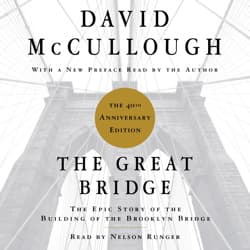

What does it take to build something that outlasts every person who touched it?
That question kept rattling around my head during the 28 hours I spent with McCullough's monument to the Brooklyn Bridge. I started this one on a drive to Houston for a client meeting and finished it three weeks later, somewhere between security audits and a particularly stubborn German Shepherd who needed his evening walks. Ranger, for the record, seemed more interested in squirrels than 19th-century engineering. His loss.
Fourteen Years, Fourteen Hundred Ways to Die
Let me cut to the chase: this is not a quick read. Twenty-eight hours is a commitment—we're talking longer than some audiobook series. But here's the thing. The Roebling family story alone justifies every minute. John Roebling, the visionary who designed the bridge, dies from a crushed foot before construction even begins. His son Washington takes over, gets the bends working in the caissons—those pressurized underwater chambers where men dug through river muck—and spends the rest of the project directing operations from his bedroom window through a telescope. His wife Emily essentially becomes the de facto chief engineer, teaching herself higher mathematics and material science to translate between her bedridden husband and the construction crews.
I've seen this scenario play out in real life—mission command passing unexpectedly, the team having to adapt or fail. That same brutal reality of ordinary people thrust into impossible situations runs through Ordinary Men, though in a far darker context. McCullough gets the human cost right. The caisson workers developing "the bends" before anyone understood decompression sickness. The political vultures circling, trying to skim contracts and replace honest engineers with cronies. Boss Tweed's Tammany Hall machine treating the bridge as just another opportunity for graft.
Runger's 28-Hour Endurance Test
Nelson Runger has this authoritative baritone that sounds like your grandfather explaining why things were better built back in his day—and actually being right about it. There's a warmth to his delivery that keeps the technical sections from becoming pure engineering lectures. When he's describing the tension in those suspension cables or the political maneuvering in the Brooklyn city council, you're there.
But I'll be honest. Somewhere around hour fifteen, during a particularly detailed section on steel wire specifications, I found myself rewinding because I'd zoned out. The voice that feels commanding at hour three can wear on you by hour twenty. Not Runger's fault—he's doing excellent work with a mammoth text. But this is where the audiobook format fights against the material. Some of the technical explanations really do benefit from diagrams you can't see.
I bumped it to 1.25x for the middle sections and dropped back to normal speed for the dramatic moments. That helped.
When Engineering Becomes Drama
McCullough spent years in archives, and it shows. But what separates this from a dry engineering history is how he frames the bridge as a character study of an era. The post-Civil War optimism. The belief that American ingenuity could solve any problem. Heart of Everything That Is covers the same era from the other side of that optimism—the frontier where American expansion meant something very different to the people already living there. The corruption that festered underneath that optimism like rot in a support beam.
There's a section where McCullough describes the opening day celebrations in 1883—the crowds, the speeches, the absolute wonder of people walking between two cities that had been separated by water since forever. Then, days later, a panic on the bridge kills twelve people. That whiplash between triumph and tragedy? That's the whole book in miniature.
Who Should Deploy and Who Should Stand Down
If you love American history, engineering, or just stories about stubborn people refusing to quit—this is essential. Perfect for long drives, yard work, or any extended activity where you can let a story wash over you for weeks. Skip it if you need fast pacing or if technical details without visual aids frustrate you. A few times I wished I could pause and look at a diagram.
Mission Complete
Twenty-eight hours is a serious commitment. But the Brooklyn Bridge took fourteen years and killed at least twenty men directly, probably more from long-term effects of caisson disease. Spending a few weeks listening to their story while driving Texas highways seems like the least I could do.
McCullough makes you understand why this bridge mattered—not just as infrastructure, but as proof that Americans could build something permanent, something beautiful, something that would still be standing when everyone who built it was long dead. The Roeblings sacrificed health, sanity, and in one case life itself for that bridge.
Ranger approved this one, though he fell asleep during the cable specifications. Fair enough, buddy. Fair enough.






![Steve Jobs [unabridged audiobook] audiobook cover](/_next/image?url=https%3A%2F%2Fcovers.audiobooks.com%2Fimages%2Fcovers%2Ffull%2F9788499923406.jpg&w=1920&q=75)