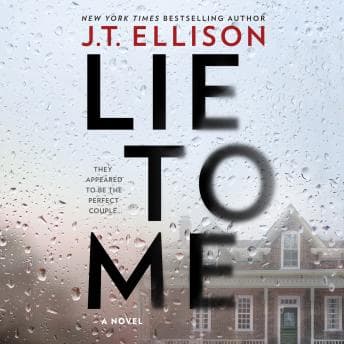

"Don't look for me."
Three words on a note. That's what Ethan Montclair wakes up to find from his wife Sutton. And I'll tell you right now—those three words kicked off about eleven hours of me sitting in my truck outside a client's office in Houston, engine running, completely forgetting I had a meeting.
Let me cut to the chase: J.T. Ellison delivers a domestic noir that operates like a well-planned ambush. You think you know the terrain, you've got your sectors covered, and then she flanks you from a direction you didn't even know existed.
The Fog of Marriage
The Montclairs are literary darlings. Published authors, beautiful home, the kind of couple that makes you sick at cocktail parties. Except everything's a lie. Their finances are a disaster. Their marriage is held together with resentment and spite. And somewhere in the middle of all this wreckage, there's a dead baby and a missing wife.
Ellison doesn't give you easy answers. Is Ethan a victim or a perpetrator? Is Sutton dead or playing the longest game imaginable? That kind of sustained misdirection reminded me of Great Train Robbery—different genre entirely, but the same tight control of information flow. Every time I thought I had the situation assessed, she'd introduce new intel that completely changed the operational picture. The woman clearly did her homework on how marriages actually fall apart. Not the Hollywood version, but the slow, grinding erosion of trust that happens when two people stop being honest with each other.
Does it require some suspension of disbelief? Yeah, in places. Some of the plot mechanics felt like they needed a bit more engineering. But I've seen enough real-world situations go sideways in ways that would make fiction editors say "too unrealistic"—so I gave Ellison the benefit of the doubt.
Four Voices, One Mission
Here's where the audio production earns its stripes. Julia Whelan, Matthew Waterson, Sarah Naughton, and Saskia Maarleveld each take on different perspectives, and it works. Whelan handles Sutton with this brittle, barely-contained energy that had me genuinely uncertain whether to sympathize with her or suspect her. Waterson gives Ethan the right amount of wounded confusion mixed with something darker underneath.
The multi-narrator approach isn't just a gimmick here—it's tactical. When you're dealing with unreliable narrators (and trust me, everyone in this book is unreliable), having distinct voices helps you track whose version of events you're hearing. Like getting intelligence from multiple sources and having to triangulate the truth.
One thing that did annoy me—and apparently I'm not alone on this—the name "Dashiell" gets butchered by at least two of the narrators. Different pronunciations for the same character. Small thing, but once you notice it, it's like a squeaky wheel on a convoy vehicle. You can't un-hear it. Quality control should've caught that.
The Cliché Question
Some folks have complained that Ellison hits every domestic thriller checkbox. The perfect couple with dark secrets. The media circus. The suspicious husband. Yeah, those elements are all present and accounted for. Secret House tried the same formula but stumbled on execution in ways that made me appreciate what Ellison pulls off here. But here's the thing—clichés become clichés because they work. The question is execution, and Ellison executes well enough that I didn't care I'd seen some of these maneuvers before.
What elevates this above standard domestic noir is the layering. Just when you think you've figured out who the bad guy is, Ellison peels back another layer. And another. By the final third, I was genuinely uncertain how this operation was going to resolve—and that uncertainty kept me locked in.
Who Should Deploy This One
If you like your thrillers with psychological complexity and don't need constant action to stay engaged, this is your mission. It's a character study wrapped in a mystery wrapped in a meditation on how well we really know the people we share our lives with.
Skip it if you need crystal-clear good guys and bad guys. Nobody in this book is innocent, and if moral ambiguity frustrates you, you'll be throwing your phone across the room by hour three.
Content warning for those who need it: discussion of infant death, some violence, and sexual content. Not gratuitous, but present.
After-Action Report
Ranger gave this one a solid head-on-paws attention level, which is high praise from him. The multi-narrator format kept things moving, the twists landed more often than they missed, and Ellison proved she can write characters as messed up and complicated as real people.
Worth your time? It's not perfect. The Dashiell pronunciation thing is sloppy, and a couple of plot points require you to not think too hard. But as a piece of psychological suspense, it accomplishes its objective. I went in expecting a standard domestic thriller and came out genuinely surprised by where it ended up.
At 1.25x speed, it's a solid two-day commute companion. Mission accomplished—with minor casualties.