
How many times can you watch a wealthy person get threatened in a beautiful house before you stop caring who did it?
I was asking myself that somewhere around hour five, sitting on the lakefront bench where Denise and I usually stop to watch the joggers. She'd gone ahead — something about not wanting to listen to me mutter at a fictional character's decision-making — and I was alone with Julia Whelan's voice and a growing suspicion that I'd figured out the twist two hours ago.
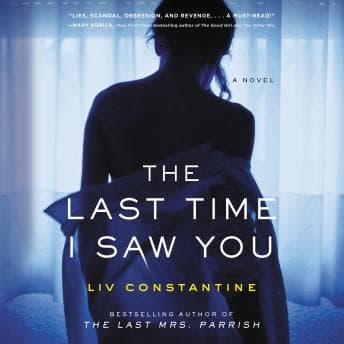
Let me back up. Liv Constantine's The Last Time I Saw You wants to be the kind of high-society psychological thriller where everyone at the dinner party might be the killer, and the real weapon is generational wealth and buried resentment. Dr. Kate English's mother is murdered, an anonymous texter starts threatening Kate, and her estranged best friend Blaire swoops in to play amateur detective among the Hermès scarves and Baltimore estates. The setup is solid — genuinely solid. That anonymous text Kate receives at her own mother's funeral? You think you're sad now, just wait. By the time I'm finished with you, you'll wish you had been buried today. That's a hook. I'll give it that.
When the Parlor Game Gets Predictable
Here's the thing about whodunits set in moneyed circles: the genre runs on a very specific engine. Everyone has secrets, everyone has motive, and the fun is supposed to be in the misdirection. Constantine understands the mechanics. The alternating suspicion between Kate's husband, her social circle, various family members — it's all there, churning along at a brisk clip for an 8-hour-41-minute listen. But I teach kids who've grown up on true crime podcasts and Knives Out. They can smell a red herring from three chapters away. And so could I.
The problem isn't that the book telegraphs its reveal — plenty of great mysteries do that and still land because the how and the why carry emotional weight. It's that the characters exist primarily as suspects rather than people. Blaire's investigation becomes this relentless, accusatory interrogation tour of Baltimore's elite, and while that sounds fun on paper, in practice it means we cycle through confrontation after confrontation without much deepening of anyone's interior life. Kate grieves, but her grief reads more like a plot function than a felt experience. This reminds me of what Hemingway said about the iceberg theory — you've got to trust what's beneath the surface. Here, what's on the surface is pretty much all there is.
Julia Whelan Doing What Julia Whelan Does
Now. Let's talk about the woman carrying this thing on her back.
Julia Whelan is — and I don't say this lightly — one of the three or four narrators working today who could make a grocery list feel like literature. Her emotional delivery here is precise and controlled. She knows exactly when to let Kate's voice crack with grief and when to pull back into the clipped, polished register of women who were raised not to make scenes. The narrator understands that pause is punctuation, and Whelan uses silence the way a good jazz musician uses rests — to create tension where the text alone might not generate enough.
But even Whelan can't solve a fundamental problem: when every character in a thriller speaks in roughly the same educated, upper-class cadence, there's only so much vocal differentiation available. You're listening for emotional texture rather than distinct voices, and Whelan delivers that. But I found myself occasionally losing track of who was speaking during dialogue-heavy passages, especially when Blaire is interrogating yet another socialite. That's not really a narrator failure — it's a writing limitation that audio makes more visible.
The performance is, by any reasonable standard, excellent. Multiple Audie Awards, Golden Voice from AudioFile — the accolades are earned. She serves the author's intent faithfully, maybe even generously. One listener I came across put it perfectly: "Even her performance can't save this story." Harsh, but it captures something real. Whelan elevates this material significantly. Without her, I'm not sure I'd have finished.
The Implausibility Problem
I won't spoil the ending, but I will say this: certain major reveals require you to accept some pretty significant leaps in logic. The kind of leaps where my AP English students would write "really??" in the margins. The thriller depends on characters making choices that serve the plot rather than their own established psychology, and by the climax, the machinery is showing. If you're the type of listener who can ride the momentum and not look too closely — and there's nothing wrong with that — you'll probably enjoy the final stretch. If you're the type who pauses and says "wait, but why would she..." then brace yourself.
Who Gets Called to the Drawing Room
If you loved The Last Mrs. Parrish, this is its spiritual successor — same DNA, same milieu, similar tricks. Pineapple Street occupies the same wealthy-people-with-secrets territory and I found myself comparing the two the whole way through — it handles the class satire with a slightly lighter touch, which depending on your mood is either a relief or a disappointment. If you're a Julia Whelan completist (and honestly, that's a perfectly valid way to choose audiobooks), this is a solid addition to your queue. It's a good focused listen for a long weekend or a couple of commutes.
But if you need your mysteries airtight and your characters three-dimensional, you might find yourself where I was on that bench — appreciating the performance, questioning the script, and wondering whether Denise was right to walk ahead.
My students would hate this. Actually, no — they'd consume it in a day and then rip it apart. Which might be the most honest compliment I can give a beach-read thriller.