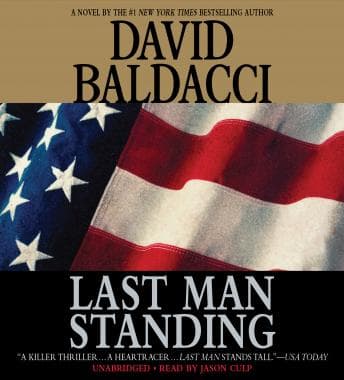

"I can't move. I can't move. I can't move."
Somewhere around hour three, Web London's internal mantra during the ambush aftermath became my own. I was cleaning out my closet at 1 AM—insomnia's a beast, might as well be productive—and I just... stopped. Sat there holding a sweater I haven't worn since 2019, completely frozen by Jason Culp's delivery of a man whose body has betrayed him at the worst possible moment.
This isn't supernatural horror. But Baldacci understands something a lot of thriller writers don't: the scariest thing isn't what's lurking in the dark. It's your own mind turning against you.
When Your Body Becomes the Haunted House
Web London is FBI Hostage Rescue Team—basically the guys they call when SWAT isn't enough. Elite doesn't begin to cover it. And then ten seconds in a dark alley leaves him the sole survivor of his entire unit, with no memory of why he couldn't move when his team needed him most.
Baldacci does something clever here that I've talked about on the podcast before: he makes the protagonist's unreliability genuinely unsettling. Is Web compromised? Is he a traitor? Is he mentally broken? I've felt that same narrative unease in A Man Called Ove, where you're never quite sure if the protagonist's perspective is reliable or just beautifully broken. The book keeps you guessing, and Culp's narration—this measured, controlled voice that occasionally cracks at the edges—sells the ambiguity perfectly. You're never quite sure if you're rooting for a hero or being manipulated by someone who doesn't even know he's been turned.
The psychiatrist sessions with Claire Daniels are where this really shines. Culp shifts into something softer, more vulnerable, and you can hear Web's defenses crumbling in real-time. These scenes drag in the best way—like watching someone slowly realize the monster they're hunting might be themselves.
Culp Commits (And That's Rare)
Look, I've listened to a lot of thriller audiobooks where the narrator treats every character like a variation on "gruff man with gun." Culp doesn't do that. He's got distinct voices for the FBI bureaucrats versus the field agents versus the criminal underworld players. There's this one character—a kid named Kevin who witnessed the ambush—and Culp gives him this wary, too-old quality that made Shirley (my cat, not Jackson) actually look up from her nap. That's my barometer. If Shirley notices, the narrator's doing something right.
The Earphones Award makes sense. Culp understands that a 22-hour thriller lives or dies on whether you can track who's talking during the complex scenes. And there are complex scenes—Baldacci throws a lot of characters at you, multiple agencies, criminal organizations, personal vendettas all tangled together.
That said: there are two extended conversations—I think one's around hour 15?—where the lack of character tags in the text creates genuine confusion. Culp does his best, but when you've got two similar-sounding male characters going back and forth for ten minutes, even good voice differentiation can't fully save you. I rewound twice. Minor frustration in an otherwise solid performance.
The Ranch Scene Problem
I have to be honest: the climactic battle sequence didn't land for me. There's a confrontation at a ranch that should feel like the payoff to 20+ hours of setup, and instead it reads like Baldacci ran out of runway. The action choreography gets muddy. The tactical precision that made the earlier FBI sequences feel authentic just... evaporates.
And the ending? Rushed. Unnecessarily bleak in a way that felt like punishment rather than earned tragedy. The final scene between Web and Claire had me muttering "oh, come on" at my closet full of clothes I'll never organize now.
This is Baldacci at his most ambitious—the psychological depth, the conspiracy layers, the exploration of trauma and masculinity and institutional betrayal. But ambitious doesn't always mean successful. The plot mechanics creak under the weight of everything he's trying to do.
Who This Is For (And Who Should Bail)
If you want a thriller that treats PTSD as more than a character quirk—that actually sits with the horror of a mind that won't cooperate with survival—this delivers. If you're a Baldacci completist, this is considered one of his stronger entries for a reason. The character work is genuinely good.
But if you need tight plotting and a satisfying resolution? Temper expectations. The journey's better than the destination here.
Skip if you're looking for something you can half-listen to while doing dishes. This requires attention. The conspiracy threads will lose you otherwise.
Final Diagnosis From the Witching Hour
I kept listening. Past the point where I should've gone to bed, past the point where my closet became a lost cause. That counts for something. Culp's performance elevates material that occasionally stumbles, and the core psychological horror of a man who can't trust his own body? That's the kind of dread I live for.
Not Baldacci's tightest work. But when it hits, it hits hard. And at 22 hours, you'll have plenty of time to decide if you're along for the ride.