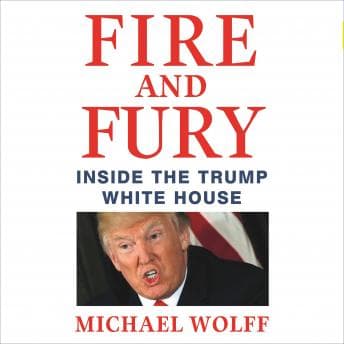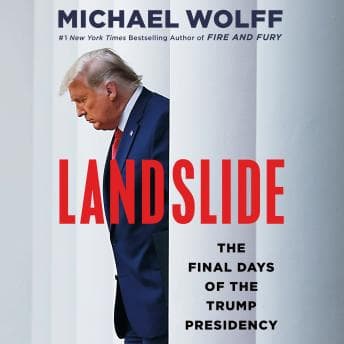

Okay so here's the thing - I don't do political books. Like, as a rule. My listening hours are sacred creative fuel, and I generally don't want to spend them white-knuckling through DC chaos when I could be ugly-crying over a perfectly timed enemies-to-lovers confession. But I was three days into a massive rebrand project for a boutique hotel client, drowning in mood boards at 2 AM, and my usual romance TBR felt too soft for my wired, overcaffeinated energy. I needed something that matched the feral pace of my brain. So I grabbed Landslide on impulse and - look, this book made me feel things I was NOT prepared to feel during a political nonfiction listen.
Let me be upfront: this is not my genre expertise. I'm a romance and memoir girl. But Michael Wolff writes politics like a telenovela, and I mean that as the highest compliment my abuela's granddaughter can give. The backstabbing, the delusion, the loyalty crumbling in real time - this felt like watching someone's tía discover a family secret at Christmas dinner, except the family is running the country.
Holter Graham Narrates Like He's Sitting in the Corner of the Oval Office With a Whiskey
This is where I got genuinely hooked. Holter Graham does this thing where he channels Trump's rambling speech patterns with this pitch-perfect mania - not a caricature, not an SNL impression, but this breathless, circling energy where sentences start somewhere and end somewhere completely different and you're just... along for the ride. It's unsettling in the best way. He captures the specific cadence of a man who genuinely believes he's winning while everything collapses around him. And then he shifts to narrating the advisors, the staffers, the people watching this unfold from inside, and his tone goes quiet, almost conspiratorial. Like he's reporting from behind enemy lines.
The archival recordings are a smart production choice. Hearing actual Rudy Giuliani audio spliced into the narrative - hearing Sidney Powell's real voice after Graham has been giving you her character - creates this whiplash between storytelling and documentary. It grounds the whole thing. Reminded me you're not listening to fiction, even when the events described feel absolutely unhinged. That same blur between documentary and storytelling is something I kept thinking about when I listened to Farewell Address — another political audio experience that messes with your sense of what's real versus performed.
Graham at 1.0x (my sacred speed, always) gives you time to absorb the layers. He doesn't rush the absurdity. There's this section about the inner circle shrinking in the weeks after the election, where Wolff describes the White House as essentially a court of last-resort sycophants feeding Trump whatever he wanted to hear, and Graham reads it with this dry, almost amused horror that had me pausing my design work just to stare at my screen.
The Telenovela Energy I Didn't Know Political Nonfiction Could Have
Wolff's writing style is gossipy in a way I actually respect? He's not pretending to be objective. He's not doing the NPR voice. He writes like someone who watched a building catch fire and is telling you about it over drinks - sharp, funny, a little mean, very specific. The "Star Wars bar scene" description of the Oval Office in the final weeks? I laughed out loud and then felt weird about laughing.
What surprised me - and this is the discovery I wasn't expecting - is that the book made me sad. Not crying-sad (my spreadsheet remains untouched by this one), but this heavy, sitting-in-your-chest sadness. There's a thread running through the whole thing about people who know better choosing not to act, about loyalty curdling into something ugly, about a man surrounded by enablers who are themselves trapped by their own enabling. Wolff doesn't editorialize this much. He just shows it. And it hit me during a 4 AM stretch of kerning hotel logos while Diego slept on my keyboard. The enabler spiral Wolff traces here has a close cousin in Witch Hunt, though that one tilts harder into the believers themselves rather than the people who knew better — I gave it three and a half stars and still thought about it for days.
Abuela would have GASPED at this book. She would've clutched her rosary and then leaned in closer. She loved a good villain arc. She loved watching powerful people make terrible decisions. She just preferred it in Spanish on Univision.
Who Should Press Play (and Who Should Keep Scrolling)
If you want neutral, measured political analysis - this is not that. Wolff has a perspective, it's sharp, and he's not apologizing. If that bothers you, skip it.
But if you want to feel like you're eavesdropping on the most chaotic workplace in America during its most chaotic moment? If you appreciate a narrator who can make committee meetings sound cinematic? If you've ever watched a reality show and thought "someone should write this down" - yeah. This one's for you. It's 11 hours that genuinely flew, and I don't say that about books outside my comfort zone.
My heart didn't break on this one. But my brain was fully engaged, and honestly? At 2 AM surrounded by color swatches and cat hair, that felt like exactly what I needed.






![Steve Jobs [unabridged audiobook] audiobook cover](/_next/image?url=https%3A%2F%2Fcovers.audiobooks.com%2Fimages%2Fcovers%2Ffull%2F9788499923406.jpg&w=1920&q=75)