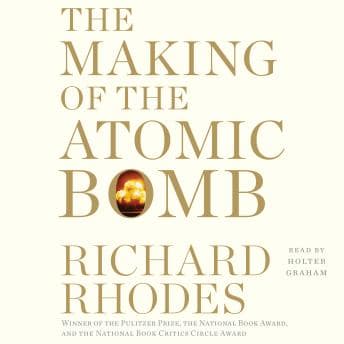

Thirty-seven hours. Let that sink in. That's longer than most of my C-17 flights to the sandbox, and I'm not exaggerating when I say this book kept me more engaged than half the briefings I sat through in my career. I started listening during a three-day drive to a client site in Denver and back, and by the time I pulled into my driveway in Austin, I was genuinely upset it was over. Ranger gave me a look like I'd lost my mind sitting in the parked truck for twenty more minutes just to finish the chapter on Hiroshima.
Let me cut to the chase: this is one of the finest pieces of nonfiction I've ever consumed in any format. Period.
37 Hours That Rewired How I Think About War
I went in expecting a straightforward history of the Manhattan Project. What I got was something far more ambitious and - honestly - far more unsettling. Richard Rhodes doesn't start at Los Alamos. He starts decades earlier, tracing the intellectual genealogy of nuclear physics from the late 1800s through the early quantum theorists. And here's what surprised me: the physics sections aren't boring. I'm not a scientist. I scraped through my engineering courses at West Point. But Rhodes has this ability to explain neutron cross-sections and chain reactions in a way that made me feel like I was actually following along. He walks you through Lise Meitner working out the math of fission on a snowy walk in Sweden, Leo Szilard's flash of insight at a London stoplight about chain reactions - these moments hit like thriller plot points because Rhodes understands that science is done by people, and people are interesting.
The biographical portraits are where this book really earns its Pulitzer. Oppenheimer comes across not as the tortured genius of popular myth, but as something more complicated - brilliant, manipulative, insecure, charismatic. His management of the Los Alamos lab reads like a case study in leadership under impossible conditions. And Niels Bohr's escape from Nazi-occupied Denmark, smuggled out in the bomb bay of a Mosquito aircraft where he nearly died from oxygen deprivation - I've read a lot of wartime escape stories. That one's up there. Sherman's memoirs captured something similar for me - the way Sherman's March to the Sea documents history's brutality through the eyes of the men making the decisions, without sanitizing what those decisions meant on the ground.
The Part Nobody Warns You About
Rhodes doesn't flinch from what the bombs actually did. The Hiroshima and Nagasaki chapters are devastating. He includes survivor accounts - a woman whose skin slid off her arms like wet gloves, children with their eyes melted shut. I've seen what modern weapons do to human bodies. I've been in rooms where those decisions get made. Reading Rhodes's account of the targeting committee casually discussing which Japanese cities to destroy over lunch - discussing things like whether Kyoto's cultural significance warranted sparing it - that hit different than any Hollywood version ever could. Because it was mundane. These were smart, decent men making calculations about mass death between bites of sandwich.
I'll be honest. There were moments in the last five hours where I had to pause. Not because it was poorly done, but because it was done too well. After 25 years in the military, I thought I'd made my peace with the calculus of war. This book made me reconsider some of that math.
Holter Graham Carries a Heavy Load
Here's the thing about a 37-hour audiobook with dense scientific and historical content: the narrator can make or break you. Graham doesn't do voices or accents - this isn't that kind of production. What he does is maintain clarity and appropriate weight across an enormous range of material. Scientific terminology comes through clean. The emotional passages don't get melodramatic. He reads like a very good professor who respects your intelligence. At 1.25x he's perfectly paced - I wouldn't go faster than that because the material genuinely requires processing time.
My one gripe, and it's minor: there are sections in the middle - particularly around the industrial production challenges at Oak Ridge and Hanford - where the level of technical detail about isotope separation methods gets pretty deep in the weeds. Necessary for completeness, but those were the stretches where my attention drifted toward the road.
Who This Is For (And Who Should Probably Pass)
If you're the kind of person who reads Tom Clancy for the technical accuracy - you'll love this. If you want military history that doesn't shy away from the moral weight of what happened - you need this. If you've ever served and wondered about the bigger strategic picture above your pay grade, this book fills in gaps you didn't know you had.
But if you want a quick overview of the Manhattan Project, this isn't it. This is the full intelligence briefing, not the executive summary. 37 hours is a serious commitment, and Rhodes doesn't cut corners.
Mission Debrief
Worth your time? Here's the debrief: this book changed how I understand the 20th century. Not just the bomb itself, but how science, politics, refugee crises, industrial capacity, and individual ego all collided to produce the most consequential weapon in human history. The author clearly did their homework - Rhodes spent years on this and it shows on every page. Ranger approved this one, though he fell asleep during the isotope separation chapters. Smart dog.




![Steve Jobs [unabridged audiobook] audiobook cover](/_next/image?url=https%3A%2F%2Fcovers.audiobooks.com%2Fimages%2Fcovers%2Ffull%2F9788499923406.jpg&w=1920&q=75)