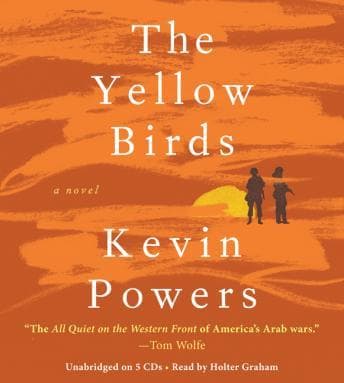

Three AM. The unit was quiet - that dangerous kind of quiet where you knock on every wooden surface you can find. I had charting to finish and six hours of audiobook to get through. The Yellow Birds seemed like the right kind of heavy for a night when sleep wasn't coming anyway.
I was wrong. Not about the book being heavy. About being ready for it.
When Someone Actually Gets It Right
As someone who's actually worked a code, who's held hands with families while delivering news that breaks them, I notice when writers understand trauma. Kevin Powers isn't guessing. He's not researching from Wikipedia. The way Private Bartle's mind fractures and loops back on itself, the way he can describe a moment of violence with almost clinical detachment and then spiral into poetry about it three chapters later - that's real. That's how trauma actually works. The brain protecting itself by refusing to process things in order.
The medical details are accurate. Finally. Not the battlefield medicine specifically, but the psychological aftermath. The way Bartle's body remembers things his conscious mind won't let him access. The way he describes dissociation - being present but not present, watching himself from somewhere outside. I've seen that look in patients. Powers captured it in words.
Holter Graham's Quiet Devastation
Some narrators would have gone big with this material. War story, young soldiers, tragedy - you can imagine the dramatic readings. Graham does the opposite. His Bartle has this quiet desperation, like someone who's used up all his emotions and is running on fumes. And Murphy - there's this breathy innocence to him that makes everything worse because you know what's coming. You know from the first chapter that this kid doesn't make it, and Graham's voice makes you feel that doom in your chest.
The differentiation between characters is subtle. Tone shifts more than accent changes. It works because this isn't a book about distinct personalities clashing - it's about two young men becoming indistinguishable in the grind of survival. Graham understood the assignment.
The Structure Will Either Work For You Or It Won't
Here's where I have to be honest. The narrative jumps around. Past to present to further past. Al Tafar to Virginia to Germany. Some listeners found this confusing - I've seen the complaints, and they're not wrong. If you need your stories linear, if you're listening while multitasking, this will lose you.
But.
This is how trauma survivors tell stories. They don't start at the beginning and march to the end. They circle. They approach the worst moment from different angles, getting closer each time until they can finally say it. The structure IS the story. Powers isn't being artsy for art's sake - he's showing you how a broken mind processes the unprocessable.
I listened to this during three night shifts. Had to pause more than once. Not because I was confused but because I needed a minute. The scenes with Murphy's mother - the promise Bartle made to bring her son home safe - Carlos asked why I was crying in the car. I blamed allergies. He didn't believe me.
Who This Is For (And Who Should Skip)
This is not background listening. This is not workout fuel. This is not "I need something light after a hard day" material. Six hours of concentrated grief and guilt and the particular hell of surviving when someone you loved didn't.
If you've read Tim O'Brien's The Things They Carried and wanted something that hits even harder, this is it. If you have family who served and you want to understand something you can't ask them about, this might help. If you work in trauma - medical, psychological, any of it - you'll recognize the truth here. Though if you're looking for something with clearer answers and less emotional devastation, State of Terror: A Novel offers a more traditional thriller framework.
Skip this if you want a war story with heroes and villains and clear moral lines. This is about what war does to the people we send to fight it. No glory. Just cost.
Charting Complete - But I'm Still Thinking About It
National Book Award finalist, PEN/Hemingway winner, and it earned every bit of recognition. Kevin Powers wrote this as a veteran and a poet, and both show. The prose is excruciatingly beautiful - the kind where you catch yourself rewinding because a sentence was so perfect you need to hear it again.
My mom would love this (she still thinks I should've been a doctor). Not because it's easy but because it's true. She's always valued truth over comfort. So do I.
Just don't start it at 3 AM when your unit is quiet. Some books need daylight and someone to talk to after.