
Okay, so I'm going to be honest with you. I picked up The Kybalion because I was in a weird headspace after a brutal week of debugging a particularly nasty race condition in our distributed cache. You know those moments where you've been staring at logs for so long that you start questioning the nature of reality itself? Yeah. So when I saw "Seven Hermetic Principles" and "ancient wisdom," my sleep-deprived brain went, "Sure, why not. Let's get philosophical."
Four hours later, I have... thoughts.
The Content vs. The Delivery Problem
Look, here's the thing about The Kybalion - the actual ideas are genuinely interesting. The Seven Principles (Mentalism, Correspondence, Vibration, Polarity, Rhythm, Cause and Effect, Gender) are basically a framework for understanding reality that predates, well, pretty much everything. And if you squint, some of it reads like proto-systems thinking? The "As above, so below" principle of Correspondence is literally just saying patterns repeat across scales of abstraction. Tao Te Ching does something similar with way more elegance and way fewer words. I've seen worse mental models in Silicon Valley pitch decks, honestly.
But - and this is a big but - the writing itself is dense. Like, "1908 esoteric text written by mysterious 'Three Initiates' who were probably just one dude named William Walker Atkinson" dense. The book repeats itself constantly, circles back on concepts, and uses this very formal, almost incantatory style that I think was supposed to feel mystical but mostly just feels... exhausting? On the page, you could skim. In audio form, you're trapped.
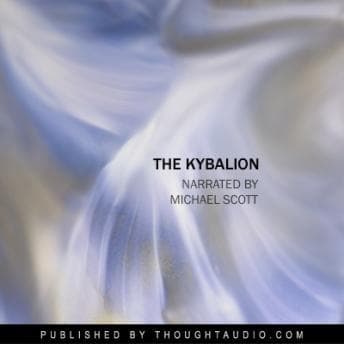
And that's where Michael Scott's narration becomes a problem.
The Narrator Situation
I want to be fair here. Michael Scott (not the Dunder Mifflin one, obviously) has clear enunciation and consistent pacing. He brought that same technical competence to Life of P.T. Barnum, though that book's inherent energy helped carry things. The production quality is clean - no weird audio artifacts, no volume jumps. Technically competent.
But here's what happened: I'm on the 6:47 AM train, we're pulling out of 4th and King, and I realize I've been listening for twenty minutes and have absorbed exactly nothing. The delivery is just... flat. Monotone. The complex philosophical concepts that already require active engagement are being read at me in this steady, unvarying stream that my half-awake brain cannot parse.
This is not a commute-worthy audiobook. I cannot stress this enough.
The Kybalion needs a narrator who can make you FEEL the weight of these ideas, who can use vocal dynamics to signal "hey, this part is important" versus "this is context." Instead, everything gets the same treatment. Principle of Mentalism? Same tone. Principle of Polarity? Same tone. The practical applications? You guessed it.
I ended up having to relisten to entire chapters because I'd zone out. And look, I listen at 1.5x minimum. I tried bumping this to 1.75x thinking maybe faster would help me stay engaged. Nope. Just monotone at higher speed.
Who Should Listen (And Who Should Skip)
Okay, so I'm not saying skip this entirely. If you're already into Hermetic philosophy, if you've maybe read the text before and want a refresher, if you're the type who can do focused listening while sitting still and taking notes - this could work for you. The content IS valuable if you can get it to stick.
Perfect for: Deep focus sessions where you're actively engaging, meditation-adjacent listening (some people use this for that apparently?), or honestly just bedtime if you want something that'll put you to sleep but leave interesting ideas floating in your subconscious.
Skip if: You need this for commute, gym, or anything where you're listening passively. If you're surrounded by zombies on a packed train at 6AM, this book will lose you by the second principle.
The ROI on this audiobook is rough. Four hours isn't long, but four hours of fighting to stay engaged is a lot. I genuinely think you'd be better off reading the physical book (it's public domain, you can find it free) or finding a different narrator version if one exists.
Bottom Line
I wanted to love this more than I did. The ideas are legitimately interesting - there's a reason this text has stuck around for over a century and influenced everything from New Thought to modern self-help. The principle of Polarity alone (everything has its opposite, and opposites are really just different degrees of the same thing) gave me a useful mental model I've already applied to debugging. Seriously. Sometimes the bug and the fix are just different points on the same spectrum.
But the audiobook experience? Meh. The narration doesn't do the heavy lifting that this dense, repetitive text desperately needs. I finished it in about 3 commutes but I had to actively fight for every bit of comprehension.
If you're curious about Hermetic philosophy, read the book. If you absolutely must do audio, sample first and be honest with yourself about whether you can handle monotone delivery of complex esoteric concepts. I couldn't. And I say that as someone who regularly listens to technical podcasts about distributed systems consensus algorithms for fun.
(Kevin asked what I was listening to and I tried to explain the Principle of Mentalism and he just slowly backed out of the room. Fair.)