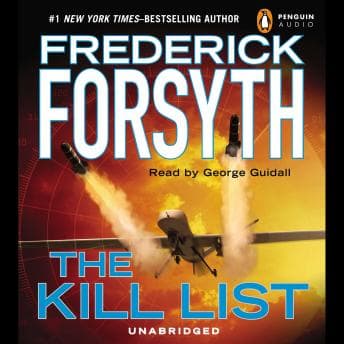

Look, I need to rant for a second. Frederick Forsyth wrote The Day of the Jackal in 1971. That book is a precision instrument — a Swiss watch of thriller writing. So when I picked up Kill List, published over forty years later, I wasn't expecting the same thing. But I was expecting Forsyth to still understand what made his early work electric: the procedural detail, the dry competence of dangerous men doing dangerous things with bureaucratic calm. And honestly? He mostly delivers. Mostly.
Here's my problem, though — and I say this as someone who sat in the back office of my library branch after hours, lights dimmed, listening to this while cataloging a donation box of water-damaged paperbacks (fitting, since half of them were Forsyth novels from the '80s). The middle third of this book nearly lost me. Not because the premise falters, but because Forsyth can't resist showing you every single step of the intelligence apparatus. Every acronym. Every agency handoff. Every meeting where men in suits agree to do a thing they were always going to do. I respect the research — the man was a journalist and a pilot, and you can feel that DNA in every chapter — but there's a stretch around hour four where the plot just... stalls. The Preacher, our antagonist, is supposed to be this terrifying online radicalization machine, and for a while he's reduced to a problem being discussed in conference rooms.
The Preacher Deserves a Scarier Book
Here's what frustrates me. The concept of the Preacher is genuinely unsettling — a faceless voice radicalizing vulnerable people through online sermons, turning them into assassins. That's real-world horror dressed up in thriller clothing, and when Forsyth leans into it, the book crackles. The early sequences where we see the Preacher's influence play out, the way ordinary people get twisted into weapons — this understands that horror isn't about gore, it's about dread. The dread of influence. The dread of not knowing who's been turned.
But Forsyth is more interested in the hunter than the hunted. The TOSA operative — code name "the Tracker" — is competent, methodical, and about as emotionally complex as a filing cabinet. Which, fine, that's Forsyth's thing. His protagonists have always been instruments rather than people. But at 8 hours and 28 minutes, you start wanting something underneath the tradecraft. Fixer pulled off exactly this trick — a procedural frame with actual emotional weight underneath it, the kind that makes the competence feel like it costs something. The personal angle — the Preacher targeting a retired Marine general whose son happens to be our guy — should land harder than it does. It's mentioned, acknowledged, and then the Tracker goes right back to being a professional. The stakes feel stated rather than felt.
George Guidall Carries the Weight
Now. George Guidall. The man is in his element here. Forsyth's novels hop across continents and cultures — you've got Somali warlords, British intelligence officers, American military brass, Yemeni operatives — and Guidall handles the multinational cast with the kind of quiet authority that keeps you oriented without ever feeling like you're listening to a one-man show. He doesn't do flashy accents. What he does is shift register — a clipped formality for the American military scenes, something looser and more weathered for the Somali sequences. The narrator commits. That's rare, especially in thrillers where so many narrators default to a single "serious man" voice and call it a day.
Guidall's pacing also saves that draggy middle section. His delivery stays controlled and unhurried, which — paradoxically — keeps you listening through passages that might've had me reaching for the skip button in print. There's a confidence in his reading that says trust the process, and mostly, I did. Clean action delivery too. When things finally accelerate in the final third, Guidall doesn't suddenly shift gears; he just tightens the screws incrementally. Professional recognizing professional.
(Shirley — my cat, not Jackson — wandered across my keyboard during the climax and I genuinely hissed at her. She was unimpressed. I was invested.)
Who Should Queue This Up (And Who Shouldn't)
If you're a Forsyth loyalist comparing everything to Jackal or Odessa File, you'll probably find this a tier below. It is. The construction isn't as tight, the antagonist stays too abstract for too long, and the emotional core is more of an emotional footnote. But if you want a procedural thriller that takes its intelligence community details seriously — the kind of book where you learn how drone strikes get authorized and how Somali pirate networks actually function — this scratches that itch.
I'd bump the speed to 1.25x through the middle stretch. You won't miss anything critical, and it'll carry you to a final act that genuinely earns its tension.
Not Forsyth's best. Not Guidall's best. But both operating at a level that most thriller audiobooks can't touch. No Limits reminded me what that ceiling actually looks like when a thriller narrator and material are genuinely locked in together. I listened in the dark — well, in a dim library back office surrounded by musty paperbacks, which is close enough. Worth the time? Yeah. Just don't expect it to haunt you after.