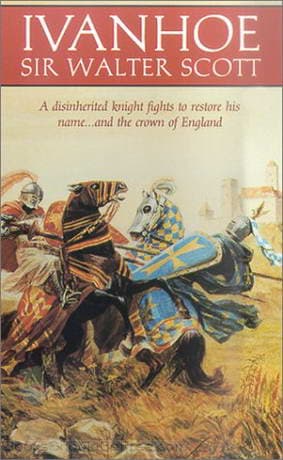

Let me be honest about something that's been bothering me for nearly twenty hours of listening: Sir Walter Scott would absolutely haunt whoever decided that multiple narrators with wildly inconsistent accents was the way to present his foundational work of historical fiction. I say this with love. I say this as someone who assigns excerpts of Ivanhoe to juniors who would rather be doing literally anything else. But good Lord, the whiplash.
I started this during one of Principal Martinez's end-of-year budget presentations—perfect cover, since I could nod thoughtfully while actually being transported to 12th-century England. Except then the narrator changed, and suddenly Richard the Lionheart sounded like he was from Cleveland. Not that there's anything wrong with Cleveland. But there's something deeply wrong with hearing "Desdichado" pronounced with a flat Midwestern affect when you're supposed to be at a medieval tournament.
The Novel That Invented Historical Fiction (No, Really)
Here's what I tell my students, and what this audiobook reminded me despite its flaws: Scott essentially created the genre we now take for granted. Before Ivanhoe, nobody was writing sweeping adventure novels set in researched historical periods with real figures woven into fictional narratives. Richard Coeur-de-Lion, Robin Hood and his merry band, the clash between Saxon and Norman—Scott assembled these elements into something that still works nearly 205 years later.
The trial by combat for Rebecca's witchcraft charge? That's the template for every courtroom drama you've ever loved, except with lances. The tournament scenes have a rhythm to them that even inconsistent narration can't entirely destroy. When a narrator hits their stride—and David McCallion does, flowing between personalities with genuine panache—you understand why this book launched a thousand imitators.
What struck me most, listening at 11 PM while half-heartedly marking essays on The Great Gatsby, was how Scott handles the Jewish characters. Rebecca and Isaac of York are written with the prejudices of their time (both Scott's 1819 and the medieval setting), and yet Rebecca emerges as arguably the most morally complex character in the entire novel. My students would call this "problematic but interesting." They'd be right. It's the kind of thing worth pausing the faculty meeting for—if you can get past the narrator roulette.
The Narrator Lottery (And Why You'll Lose)
This is where I have to be direct. The "Various" credit on this audiobook isn't a charming ensemble cast situation. It's chaos. You'll be following Ivanhoe's disobedience of his father Cedric, getting invested in the Saxon-Norman tensions, and then—without warning—a completely different voice takes over. Some are excellent. A female narrator handles her sections with clarity and proper pacing. Others sound like they're reading from a teleprompter for the first time. The same lottery plays out in Captain Blood, another Various-narrator production where the gap between the best and worst voices is wide enough to sail a ship through.
One listener review I came across said Scott would "turn in his grave" over the clipped North American accents, and while that's perhaps harsh, it's not wrong. Medieval England deserves a certain gravity. When your Templar knights sound like they're ordering at a drive-through, the spell breaks.
Denise walked in during one of the better-narrated combat scenes and asked what I was listening to. "The book that invented Robin Hood as we know him," I said. She stayed for ten minutes. Then a narrator switch happened and she wandered off to watch Bridgerton. I can't blame her.
Interestingly, Field Trip pulls off the same multi-narrator format without that whiplash—worth a listen as a reminder that "Various" doesn't have to mean "chaos."
Who Should Brave This Version (And Who Should Flee)
If you're a completist who needs to experience Scott's prose and you've got a high tolerance for inconsistency, this will work. If you're introducing yourself to Ivanhoe for the first time, hunt for a single-narrator version—this story deserves better than feeling like you're channel-surfing through the Middle Ages. Skip this one if you need smooth, immersive listening; the narrator switches will yank you out of the story every time you settle in.
Scott's language is already dense. (This reminds me of what Hemingway said about how every writer owes a debt to the writers before them—and every writer after Scott owes him for proving historical fiction could be both popular and literary.) Adding narrator confusion to archaic prose creates an accessibility problem that didn't need to exist.
Best for: Dedicated listening sessions where you can power through the rough patches. Not for commutes unless you want to miss your stop during a narrator transition. Definitely not for bedtime—you'll either be too annoyed to sleep or too confused to follow.
A Passing Grade, But Just Barely
I finished it. That counts for something. The story underneath the production chaos is genuinely good—the romance between Ivanhoe and Rowena, Rebecca's unrequited love, the moral complexity of crusade-era Christianity, the surprisingly modern treatment of religious prejudice. These elements survive even mediocre narration.
But here's my honest verdict: this particular audiobook version asks too much patience of the listener. At 19 and a half hours, you need consistency. You need a narrator who understands that pause is punctuation, that Scott's prose deserves to be savored. What you get instead is a grab bag.
My students would hate this. I love the source material. The execution? That's a different essay entirely.