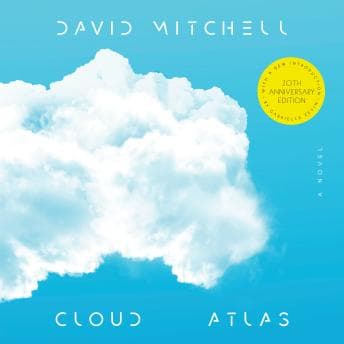

Okay, so imagine someone took six completely different genres - 19th century sea voyage, 1930s epistolary drama, 70s conspiracy thriller, present-day comedy, dystopian sci-fi, and post-apocalyptic survival - threw them in a blender, and somehow made it work. That's Cloud Atlas. And honestly? The audiobook format might be the only way to experience this thing properly.
I started this during a particularly brutal coding session when I was supposed to be debugging my procedural terrain generator. Twenty hours later, my thesis was no closer to done, but I'd experienced something that felt like reading six interconnected campaigns from the same D&D universe across different eras. Worth it? Absolutely. Dr. Patel would disagree.
The Narrative Nesting Dolls
Here's the structure, because Mitchell is basically showing off: the book opens with Adam Ewing's story in 1850, cuts off mid-sentence, jumps to 1931 Belgium, cuts off, jumps to 1970s California, cuts off... you get it. It climbs all the way to a post-apocalyptic Hawaii, then reverses course and closes each story in reverse order. It's like a literary matryoshka doll designed by someone who really, really loved puzzles.
And look - this is Sanderson-level world-building, except instead of one magic system across thousands of pages, you get six completely different genres with their own rules, tones, and stakes. That same kind of genre-hopping ambition shows up in Giving Up The Ghost, though on a much smaller scale. Each section references the previous one in subtle ways. Characters find journals, watch movies, read manuscripts from earlier eras. Souls echo across time. It's ambitious as hell.
The problem? This demands your full attention. I tried listening while grinding in an MMO and had to restart the Timothy Cavendish section twice. This is not a background listen. This is a "pause the game, close Discord, actually focus" listen.
Six Narrators, Six Voices, One Wild Ride
The production team made the right call giving each section its own narrator. Scott Brick handles the 1850s journal with this measured, commanding presence that makes you feel like you're reading by candlelight. Richard Matthews brings the right amount of pretension and desperation to Frobisher's letters. Cassandra Campbell nails the pulpy thriller vibe of the Luisa Rey mystery.
But the real standouts? Kim Mai Guest as Sonmi~451 is genuinely haunting. The Korean dystopia section could've felt cold and clinical, but she brings this quiet humanity to a cloned "fabricant" questioning her existence. It's the emotional core of the whole book, and she absolutely nailed it.
And then there's Kirby Heyborne doing the post-apocalyptic Hawaiian pidgin dialect of Zachry's section. This is where the audiobook format becomes essential. That dialect on the page? Rough going. My D&D group would've given up after three pages. But hearing it performed? It clicks. The rhythm makes sense. The words stop being obstacles and start being music.
John Lee's Timothy Cavendish section is pure dark comedy gold. A cranky British publisher trapped in a nursing home, raging against everything? Lee's timing is impeccable.
Where It Drags (And Where It Flies)
I won't lie - the pacing is uneven. Every time you're invested in one story, Mitchell yanks you into another. The first time Ewing's narrative cut off mid-sentence, I actually checked if my download was corrupted. (It wasn't. Mitchell's just like that.)
The Luisa Rey section reads like a 70s airport thriller, which is... fine? It's the weakest link for me, though Cassandra Campbell does her best with it. And the Cavendish section starts slow before becoming genuinely hilarious.
But when this book hits, it hits hard. The Sonmi interrogation. The final revelations in Zachry's section. The way everything connects without being heavy-handed about it. There are moments where Mitchell is basically asking "what if our actions echo across centuries?" and somehow making it feel earned rather than preachy.
Roll for Initiative (Or Don't)
Here's the thing: Cloud Atlas is not for everyone. If you want a straightforward story with a clear protagonist and a tidy ending, run away. If you're looking for easy listening during your commute, this will frustrate you. Skip it.
But if you're the kind of person who appreciates structural experimentation, who gets excited when narratives nest inside each other, who wants to feel like you're experiencing something genuinely ambitious - this is your audiobook. The multiple narrators transform what could be a confusing literary exercise into something genuinely immersive. This one's for the world-building nerds, the puzzle-solvers, the people who read appendices for fun.
I finished it at 2 AM, immediately texted my D&D group "you need to listen to this," and then stared at my thesis document for ten minutes before giving up and going to bed. Some books are just more important than graduate school progress.
(Don't tell Dr. Patel I said that.)