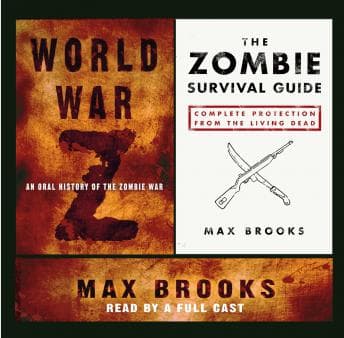
Look, I need to address something before we get into this. I've been hosting a horror podcast for over 200 episodes, and I've always been slightly dismissive of zombie fiction. It felt like the genre equivalent of comfort food - satisfying, sure, but rarely scary. Zombies shuffle. They groan. They're predictable. Where's the dread?
Max Brooks made me eat those words. With a full cast of Hollywood heavyweights doing the chewing.
The Oral History Format Actually Works
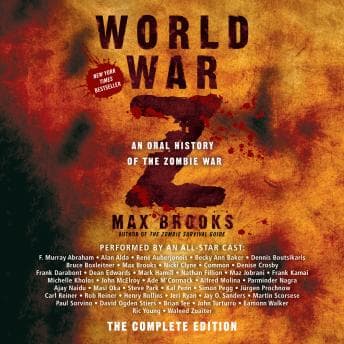
Here's what I didn't expect: World War Z isn't really about zombies. I mean, yes, the undead are everywhere, but this is a book about systems failing. About governments making impossible choices. About the gap between what we think we'd do in a crisis and what we actually do. The oral history format - which could've been gimmicky - ends up being the smartest structural choice I've heard in horror audiobooks this year.
Each interview feels like a documentary you'd watch at 2 AM on a streaming service, the kind where you keep saying "one more segment" until suddenly it's 4 AM and you're questioning humanity. The testimonies range from a Chinese doctor who encountered Patient Zero to a soldier describing the Battle of Yonkers (a military disaster that had me pausing the audiobook to process what I'd just heard). The global scope is genuinely impressive. Brooks doesn't just give us the American perspective - he gives us South Africa's brutal Redeker Plan, Japan's otaku-turned-warrior, Cuba's transformation into a world power.
Shirley Jackson walked so Max Brooks could... well, shamble. But effectively.
Why This Cast Commits
The narrator situation here is wild. This is a full-cast production featuring Alan Alda, John Turturro, Rob Reiner, Mark Hamill, and others. And here's the thing - they don't phone it in. Mark Hamill doing a traumatized soldier? Devastating. The accents representing global perspectives could've been cringeworthy, but the production team clearly took care to make them feel authentic rather than performative.
Max Brooks himself serves as the interviewer throughout, and I'll be honest - his narration is the weakest link. Not bad, just noticeably less dynamic than the professional actors surrounding him. It's like watching a documentary where the host is fine but the interview subjects are magnetic. You don't mind, but you notice.
The production quality is genuinely excellent. Clean audio, subtle sound design that enhances without overwhelming. This won the 2007 Audie Award for Best Multi-Voiced Performance, and yeah, I get it.
The Survival Guide: A Different Beast
Now, the combo includes The Zombie Survival Guide, which is... a different vibe entirely. It's presented as a straight-faced survival manual, complete with weapon recommendations ("Blades don't need reloading" - honestly, solid advice) and home fortification strategies. It's more darkly comedic than genuinely scary, but it works as a companion piece. Think of it as the appendix that makes the main event feel more grounded.
I listened to parts of this while meal prepping, which felt oddly appropriate. Nothing like chopping vegetables while learning the optimal way to decapitate the undead.
Where the Dread Actually Lives
What makes this horror - real horror - isn't the zombies. It's the humans. The testimonies about people trampling each other during evacuations. The governments that prioritized optics over survival. The families who made impossible choices about who to save. Nightingale: A Novel explores that same territory of impossible wartime choices, though in a very different historical context. One interview about the "Quislings" - living humans who psychologically broke and started acting like zombies - genuinely disturbed me in a way that gore never could.
This understands that horror isn't about monsters. It's about what the monsters reveal about us.
I listened to chunks of this in the dark (because that's how horror is meant to be consumed, obviously). The Battle of Yonkers section? I had to turn the lights on. Not because of zombies - because of the systematic military failure. The incompetence. The preventable deaths. That's the nightmare fuel.
Who Gets Bitten, Who Should Run
If you want a traditional zombie romp with clear heroes and satisfying kills, this might frustrate you. The oral history format means you're constantly jumping perspectives, and some listeners find that disorienting. Also, make absolutely sure you're getting the Complete Edition - apparently earlier abridged versions cut significant content, and you'd be missing some of the best interviews.
But if you want horror that functions as social commentary? If you appreciate world-building that feels exhaustively researched? If you've ever wondered what a Ken Burns documentary about the apocalypse would sound like? This is your audiobook.
End Transmission
My podcast listeners are going to love this.
Shirley (my cat) was unimpressed by the zombie groans. I was genuinely unsettled by the human ones.