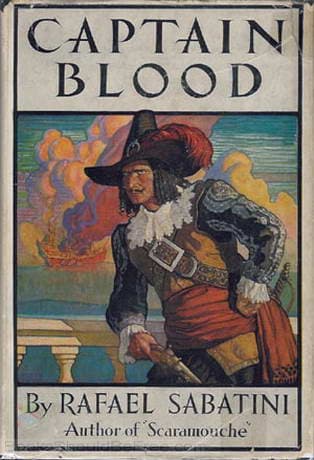

I'll admit something that might get my English teacher card revoked: I'd never read Sabatini. Heard the name plenty—usually in the same breath as Dumas and Stevenson—but somehow Captain Blood had slipped through the cracks of my supposedly comprehensive literary education. So when I finally pressed play during a particularly brutal stack of sophomore essays on The Scarlet Letter (irony noted), I wasn't sure what to expect from a 1922 adventure novel about pirates.
What I got was twelve hours of pure, unapologetic swashbuckling joy. And a renewed faith that some stories simply deserve to be heard aloud.
Sabatini's Sentences Demand to Be Spoken
This is why we still read the classics. Sabatini writes with a precision that modern thrillers have largely abandoned. Peter Blood's journey from Irish physician to reluctant slave to legendary pirate captain unfolds with the kind of deliberate pacing that rewards patience. The prose is ornate without being suffocating—sentences that curl and build, dialogue that crackles with wit and barely concealed contempt.
Robert Whitfield understands that pause is punctuation. His reading doesn't rush through Blood's sardonic observations or his verbal sparring matches with the pompous Colonel Bishop. There's a moment early on—Blood's trial, where the injustice of Jeffreys' Bloody Assizes becomes viscerally clear—where Whitfield's restraint makes the cruelty land harder than any theatrical outburst could. He trusts Sabatini's words. That's rarer than it should be.
Now, I should mention there are multiple versions floating around. Some full-cast productions exist that apparently range from "mediocre acting" to "mannered and sepulchral" according to fellow listeners. I can't speak to those. The Whitfield solo narration is the version that had me ignoring Principal Martinez's third email about curriculum updates.
When the Cannons Fire
The sea battles. Good lord, the sea battles. Sabatini clearly did his homework on 17th-century naval warfare, and Whitfield throws himself into these sequences with genuine intensity. There's a boarding action about halfway through where Blood's tactical genius becomes apparent—not through exposition, but through the chaos of combat rendered in vivid, almost cinematic detail. No sound effects in this version, just Whitfield's voice carrying the thunder of cannons and clash of steel through pure performance.
This reminds me of what Hemingway said about writing action—the iceberg theory, where what's unsaid matters as much as what's on the page. Sabatini inverts this. He gives you everything: the spray of salt water, the splinter of wood, the specific angle of a cutlass stroke. It shouldn't work. It absolutely works.
My students would hate this. The vocabulary alone would send them scrambling for their phones. Words like "supererogatory" and "contumely" appear without apology. Sentences stretch across half a page before finding their period. I love it. This is prose that assumes its readers are intelligent adults who enjoy language—a courtesy increasingly rare in contemporary fiction.
Blood Himself Is the Real Treasure
Peter Blood is a fascinating protagonist precisely because he's not a natural pirate. He's a physician who quotes Domus and speaks multiple languages, forced into outlawry by the brutal stupidity of English colonial justice. His transformation isn't a descent—it's an adaptation. He brings a surgeon's precision to piracy, treating it as a problem to be solved rather than a life to be embraced.
Whitfield captures this duality beautifully. There's an aristocratic edge to Blood's speech that never quite disappears, even when he's threatening Spanish captains or negotiating with other buccaneers. The contrast between his cultivated manner and his ruthless effectiveness is the engine that drives the whole narrative.
If you loved Dumas' Count of Monte Cristo—that same sense of justified vengeance wrapped in elaborate plotting—this is its spiritual successor on the high seas. That blend of folklore and larger-than-life storytelling also shows up in Truth About Tall Tales: American Folklore from Johnny Appleseed to Paul Bunyan, though obviously in a completely different context. The romance subplot with Arabella Bishop is perhaps the weakest element (Denise, listening alongside me during our lakefront walks, had some pointed observations about 1920s gender dynamics), but it serves its purpose without derailing the adventure.
Who Should Weigh Anchor (And Who Should Stay Ashore)
This is for readers who miss when adventure meant something—when heroes were clever rather than just strong, when villains were genuinely despicable, when prose took its time building toward moments that earned their drama. If you need constant action and modern pacing, you'll struggle. If you appreciate the difference between a story that respects your intelligence and one that merely entertains your reflexes, Captain Blood delivers.
Skip if: You find ornate Victorian-era prose exhausting, or if you're looking for historically accurate piracy (this is romantic adventure, not gritty realism). Also maybe skip the full-cast versions unless you're feeling adventurous yourself.
Class Dismissed—Go Listen
Twelve hours is a commitment. I won't pretend otherwise. But Whitfield's performance transforms what could be a dated adventure yarn into something genuinely transporting. By the final chapters, I found myself deliberately slowing down, not wanting it to end—a feeling I haven't had with an audiobook since my first listen of Patrick O'Brian's Aubrey-Maturin series.
Sabatini understood something essential about storytelling: that adventure without character is just noise, and character without stakes is just biography. Captain Blood gives you both, wrapped in language that demands to be spoken aloud. After twenty years of teaching literature, I can say with confidence—some books were always meant to be heard.
Now if you'll excuse me, I have forty-seven podcast listeners waiting for my take on how Sabatini influenced the entire pirate genre. Mom, try to stay awake for this one.