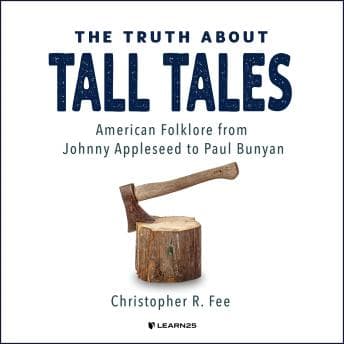

Christopher Fee isn't just teaching you about Paul Bunyan. He's teaching you about yourself.
That's the thing about this audiobook that caught me off guard. I expected a fun romp through American tall tales - Johnny Appleseed, John Henry, maybe some Pecos Bill thrown in for flavor. What I got was something closer to a cultural psychology course disguised as folklore appreciation. And honestly? I'm here for it.
The Professor Who Narrates His Own Work
Fee is a medievalist and English professor at Gettysburg College, which you can absolutely hear in his delivery. This isn't a dramatic performance - it's a lecture series, and I mean that as a compliment. The man clearly loves this material. He's not reading at you; he's explaining something he's spent decades thinking about. There's a difference.
Now, I'll admit - when I saw "author-narrated" I had my reservations. We've all been burned by authors who write beautifully but sound like they're reading a grocery list. Fee doesn't have that problem. His pacing is deliberate (maybe too deliberate for the 2x speed crowd, but I'm not one of them), and he knows when to pause for effect. When he's explaining why Daniel Boone became a folk hero while other frontiersmen faded into obscurity, you can hear him connecting dots in real time. It's the sound of someone thinking, not just reciting.
Why These Stories Survive (And What That Says About Us)
Here's where Fee really shines. He's not interested in simply debunking these tales - that would be too easy, and frankly, kind of boring. Instead, he does something smarter: he shows you how the real lives of these figures were already remarkable before the mythmaking began. Johnny Appleseed wasn't just some wandering eccentric scattering seeds. The actual John Chapman was a Swedenborgian missionary with a genuine vision for the American frontier. The legend simplified him, but the truth was already strange.
The same goes for John Henry. Fee traces how a probably-real railroad worker became a symbol for human resistance against mechanization, and then - this is the part that got me - he shows how that symbolism shifts depending on who's telling the story and when. A tale about a Black laborer dying to prove his worth against a machine means something different in 1870 than it does in 1970 than it does now.
This is what I try to get my students to understand about literature. Stories aren't static. They're living things that change based on who needs them.
That idea of transformation under pressure—how narratives shift to serve different needs—is something I saw play out in Red Rising, where the mythology of a stratified society gets weaponized and rewritten by those it was meant to suppress.
The Weird Stuff Gets Weird
Fee doesn't stick to the familiar territory. He goes into Water Jar Boy (a Pueblo tale I'd never encountered), La Llorona (which I knew but never really understood the regional variations of), and the Headless Horseman (which, let's be honest, most people only know from the Disney cartoon). The section on "fakelore" - manufactured folklore created for commercial purposes - is particularly fascinating. Turns out a lot of what we think of as ancient American tradition was invented by advertising executives in the early 20th century. Paul Bunyan? Largely a lumber company mascot. My students would hate this. I love it.
The conspiracy theory and urban myth lectures toward the end feel like a natural extension, though they're covering ground that's been well-trodden elsewhere. Still, Fee's framework - that these modern myths serve the same psychological and cultural functions as the older ones - is worth sitting with.
The Pacing Question
At 10 hours and 24 minutes across 24 lectures, this is clearly designed for the "one lecture per commute" listener. Each section is self-contained enough that you won't be lost if you take a few days between sessions. I listened over about three weeks, mostly during my lakefront walks with Denise, and the format worked well for that. She'd ask what I was learning, I'd summarize a tale, and we'd end up talking about what stories our own families told.
That said - if you're looking for pure entertainment, this might not be your speed. It's educational content. Good educational content, but still. The production is clean, professional, exactly what you'd expect from Learn25. No music stings, no dramatic recreations. Just Fee and his material.
Who Should Listen (And Who Should Skip)
Teachers, absolutely. Parents who want to actually understand the bedtime stories they're telling. Anyone who's ever wondered why Americans keep returning to certain heroic archetypes while ignoring others. If you've read any of Joseph Campbell's work on mythology and wanted an American-specific application, this is pretty close to what you're looking for.
Skip it if you want a dramatic reading of the tales themselves. Fee summarizes more than he performs. That's a feature, not a bug, but know what you're getting into.
Worth pausing the faculty meeting for? Absolutely. (Sorry again, Principal Martinez.)