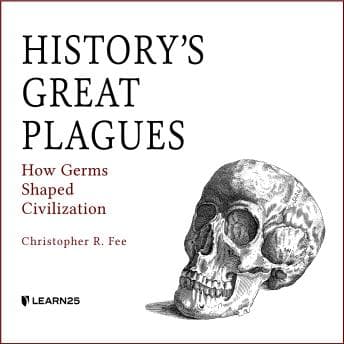

Look. I need to rant for a second. When I downloaded this at 11 PM after three days of on-call rotations, I was expecting virology meets history. You know, the science of how pathogens literally reshaped human civilization. The title says "How Germs Shaped Civilization." That's a promise. What I got instead was a literature course.
And honestly? Once I stopped being annoyed about the bait-and-switch, I found myself genuinely fascinated.
The Bait-and-Switch That Actually Works
Bottom Line: This is basically a Great Books seminar for plague literature. Professor Chris Fee walks you through how writers from the Bible to 12 Monkeys have processed, metaphorized, and grappled with pestilence. It's not epidemiology. It's not R0 values and transmission rates. It's Boccaccio's Decameron, Camus' The Plague, medieval poetry, and how humans have narrativized mass death for millennia.
Once I recalibrated my expectations—probably around lecture three, somewhere between the Iliad's plague and Thucydides—I started appreciating what Fee was actually doing. He's a medieval literature professor at Gettysburg College, and it shows. The dude clearly loves this material. His analysis of how the Black Death fundamentally altered European literary consciousness? Actually compelling. The connections he draws between ancient plague narratives and our COVID moment? Surprisingly relevant. Before We Were Yours does something similar with historical trauma—taking real events and examining how we narrativize collective suffering.
At just under 5 hours, this is a quick listen. I finished it in two commutes plus a late-night insomnia session where I couldn't turn my brain off after debugging a particularly nasty race condition. The lecture format works for this kind of content—twelve discrete chunks, each building on the last.
When the Professor Hits Record
Here's where things get rough. Fee narrates his own course, which makes sense for a lecture series. But the delivery... oof. There's a lot of stammering. A lot of "um"s and "uh"s. Pauses that stretch just a beat too long. It's clearly not a professional audiobook narrator situation—it's an academic who's comfortable in a classroom but maybe less so in a recording booth.
I cranked it to 1.75x immediately. Even then, the pacing felt sluggish. At normal speed, I genuinely don't know how anyone gets through this. It's not that his voice is unpleasant—he actually has this warm, professorial quality when he gets rolling. But the verbal tics are constant enough that they pulled me out of the content repeatedly.
This is the kind of audio quality that makes me appreciate how good professional narrators actually are. Ray Porter this is not.
Who Should Queue This Up (And Who Should Hard Pass)
Perfect for: English lit majors, humanities nerds, anyone who wants to understand why plague narratives follow certain patterns. If you've ever wondered why pandemic fiction hits the same beats over and over—the denial phase, the breakdown of social order, the philosophical reckoning—Fee actually explains the literary lineage.
Skip if: You're expecting hard science. If you want to know how the bubonic plague actually spread, or the biology of viral transmission, or the epidemiological models that predict pandemic curves—this ain't it. Also skip if audio quality is a dealbreaker for you, because this will drive you insane.
The ROI on this audiobook is weird. The content itself is genuinely interesting and I learned things I didn't know—like how Defoe's Journal of the Plague Year basically invented the fake documentary format in 1722. But the listening experience is a slog that requires active effort to push through.
The Debug Report
I keep coming back to this: the ideas are good, the execution is rough. It's like reviewing a codebase with solid architecture but terrible variable naming and no comments. You can see the intelligence behind it, but the implementation makes you work harder than you should have to.
Fee clearly knows his stuff. His enthusiasm for connecting ancient texts to modern pandemic experiences is genuine and occasionally infectious (sorry, had to). But author-narrated academic content is a gamble, and this one doesn't quite land on the audio front.
Worth it if you're specifically interested in plague-as-literary-device and can tolerate imperfect audio. Stream it through your library app rather than burning a credit. And for the love of all that is holy, use the speed controls.