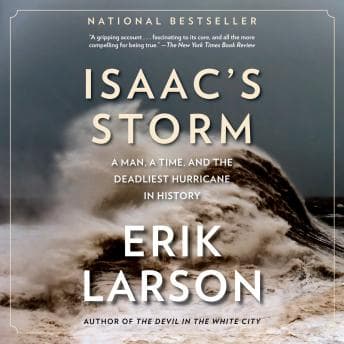

What happens when the smartest person in the room is also the most dangerously wrong?
That's the question that kept rattling around my head at 11PM on a Tuesday, Kevin already asleep, me on the couch with the lights off because I couldn't stop listening. I'd picked up Isaac's Storm thinking it'd be a solid narrative nonfiction listen for my commutes - Erik Larson, hurricane, Galveston, sure. What I didn't expect was to be physically tense on my own couch, already knowing the outcome, already knowing thousands of people die, and still feeling my stomach drop as the water rose.
The Postmortem Nobody Wanted to Write
So here's the setup: Isaac Cline is the head meteorologist for the U.S. Weather Bureau in Galveston, Texas, circa 1900. He's smart. He's credentialed. He's also published a paper essentially arguing that a hurricane could never seriously damage Galveston. This is basically a senior engineer writing a design doc that says "this system can't fail" and then watching it fail catastrophically in production.
Larson does this thing where he braids together three threads - Isaac's personal story and professional hubris, the politics of the Weather Bureau (which was actively suppressing Cuban meteorologists' warnings because... American exceptionalism, basically), and the raw physics of what a Category 4 hurricane actually does to a coastal city with a max elevation of 8.7 feet. The science actually holds up. Larson explains pressure gradients and storm surge mechanics in a way that's accessible without being dumbed down. As someone who spends her days thinking about cascading system failures, the parallels to distributed systems disasters are almost uncomfortable. Single points of failure everywhere. Ignored monitoring alerts. A culture that punished people for raising alarms.
The slow build is intentional and effective. The first half is all context - Gilded Age Galveston as this booming, wealthy port city, Isaac's career trajectory, the bureaucratic turf wars between the U.S. and Cuban weather services. It's not fast. But it's doing critical work, because when the storm finally hits, you understand exactly why nobody was prepared. You understand the systemic arrogance.
When the Water Comes
And then the hurricane hits and the book just... transforms. The descriptions of the storm itself are visceral in a way that had me pulling my hoodie tighter even though I was perfectly safe in my living room. Larson reconstructs the experience from survivor testimonies - slate roof tiles becoming airborne guillotines, entire neighborhoods compressed into massive walls of debris that ground through the city like a garbage compactor. Isaac wading through chest-deep water with his pregnant wife and three daughters, watching his house literally disintegrate around them.
The moment Isaac loses his wife - she's ripped from his grasp by the surge while they're clinging to debris - is rendered with this terrible restraint that makes it hit harder. Larson doesn't melodramatize it. He just reports what happened. And you sit there in the silence between chapters and feel the weight of it.
Richard M. Davidson's narration is a big part of why this works as an audiobook. He reads the pre-storm sections with this undercurrent of tension - he doesn't play it naive, doesn't pretend we don't know what's coming. There's a gravity to his tone even in the early chapters about Weather Bureau politics that keeps you locked in. When the storm arrives, he escalates his intensity without ever tipping into melodrama. It's controlled and deliberate, like he trusts the material to do the emotional heavy lifting. Good instinct. Earphones Award winner, and yeah, I get it.
The 6AM Train Test
TL;DR: Worth your commute, but with a caveat.
Here's where I have to be honest. The first third of this book - the Weather Bureau politics, Isaac's early career, the context-setting about Galveston's economy - requires real attention. I tried it on my 6AM Caltrain and found myself rewinding. Not because it's boring, but because the details matter and they build on each other. The bureaucratic rivalry between the U.S. Weather Bureau and Cuban forecasters is actually fascinating (Cuba was getting the storm science RIGHT and being deliberately ignored), but you need to be tracking names and institutional dynamics.
Once the storm hits, though? You could listen to that section during a fire alarm and still be riveted.
At 8 hours 47 minutes, it's a clean 4-commute listen at 1.5x. I'd actually recommend staying at 1.25x for this one, especially through the storm chapters. Davidson's pacing is already well-calibrated and speeding it up robs some of the building dread.
Perfect for: roadtrip, dedicated listening sessions, evening wind-down (if you can handle the intensity). Skip for: background listening, half-attention commutes.
If you've read Devil in the White City, this is Larson doing the same narrative nonfiction thing but tighter and more emotionally devastating. Honestly, the only audiobook I've reviewed recently that felt comparably immersive in its world-building was Stones of Venice, Volume 2 - though that one asked a lot more of me on the 6AM train and delivered considerably less dread. Less sprawling, more focused. The ROI on this audiobook is high - it's an 8-hour education in meteorology, institutional failure, and human arrogance wrapped in a story that genuinely moved me. And I'm someone who debugs distributed systems for a living. I thought I was immune to cascading failure narratives.
I was not.








![Steve Jobs [unabridged audiobook] audiobook cover](/_next/image?url=https%3A%2F%2Fcovers.audiobooks.com%2Fimages%2Fcovers%2Ffull%2F9788499923406.jpg&w=1920&q=75)