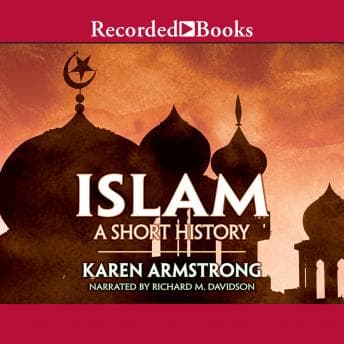

Karen Armstrong deserves better.
Let me cut to the chase—this is an excellent book hamstrung by a narrator who apparently never consulted anyone who's actually heard Arabic spoken. I finished this one during a long drive back from a client site in Houston, and I lost count of how many times I winced at "Hu-sign" instead of Hussein. We're talking about one of the most common names in Islamic history, and Davidson treats it like he's reading a prescription label for the first time.
The Mission Brief
Armstrong's goal here is ambitious: compress 1,400 years of Islamic history into under seven hours while making it accessible to Western listeners who might know nothing beyond what cable news tells them. And she largely succeeds. The book moves from Muhammad's flight from Mecca through the Abbasid golden age, the Mongol invasions, Ottoman expansion, colonialism, and into modern fundamentalism. It's a lot of ground, but Armstrong doesn't get lost in the weeds.
What I appreciated—and I've spent enough time in Muslim-majority countries to have some context here—is that she doesn't treat Islam as a monolith. She traces the Sunni-Shia split, explains how Sufism developed as a mystical counterweight to legalism, and shows how political circumstances shaped religious interpretation at every turn. The section on how European colonialism fundamentally disrupted traditional Islamic political structures? That's the kind of context you don't get from most Western sources. I've seen those disruptions play out in real life, in villages where the old systems were gone but nothing coherent replaced them.
Where the Audio Becomes a Liability
Richard Davidson has a good voice. Clear, well-modulated, avoids that droning monotone that kills so many nonfiction audiobooks. But here's the thing—when you're narrating a book about Islam, you're going to encounter Arabic terms on nearly every page. Caliphs, dynasties, theological concepts, place names. And Davidson mangles them consistently enough that it becomes genuinely distracting.
This isn't about expecting perfect Arabic pronunciation from an English narrator. I get it. But when basic terms that any undergraduate Middle East studies student would know are getting butchered, it undermines the scholarly credibility of the whole project. Armstrong clearly did her homework. Davidson apparently didn't do his.
Ranger gave me a look around hour three—even he could tell something was off. (He's heard me curse at enough bad military details in thrillers to recognize the frustration.)
Academic Pacing, For Better and Worse
Armstrong writes like the academic she is. This isn't a narrative history with colorful characters and dramatic scenes—it's more of a survey course in audiobook form. Not a criticism, just a reality check. If you're looking for the kind of storytelling you get in Dan Carlin's Hardcore History, this isn't it.
At 1.25x speed, the pacing felt about right. The material is dense enough that you need some processing time, but not so complex that you'll get lost if you're also navigating I-10 traffic. Solid commute material—engaging enough to hold attention, but not so gripping that you'll miss your exit.
The book's age shows in spots. Published in 2000, it obviously can't address the past two decades of Islamic history—no Arab Spring, no ISIS, no current geopolitics. For historical context up through the 20th century, though, it holds up well.
Who Should Deploy This (And Who Shouldn't)
If you want a foundational understanding of Islamic history from a respected scholar, this delivers. It's particularly valuable for anyone who's realized their knowledge of Islam consists mostly of news headlines and wants to fill that gap. The book is fair-minded without being preachy, scholarly without being impenetrable. Armstrong's approach to cultural context reminded me of what Thomas Sowell does in Black Rednecks and White Liberals—challenging assumptions by showing how historical circumstances shaped entire communities.
Skip it if pronunciation accuracy matters to you—and honestly, for a book about Islam, it probably should. Also skip if you need narrative drive to stay engaged. This is textbook-adjacent material, just in audio form.
Mission Assessment
Here's my honest assessment: read the print version. Armstrong's work is worth your time, but this audiobook production doesn't do it justice. The pronunciation issues aren't minor quibbles—they're a persistent distraction that undermines what should be an authoritative introduction to a major world religion. Worth the information, but the delivery method needs work. Ranger and I are calling this one a qualified recommendation at best.