
I was sitting on my back porch last Tuesday night, Ranger sprawled across my feet, watching a thunderstorm roll across the Hill Country. Linda had gone to bed hours ago. I had about four hours left on this one and I wasn't going anywhere.
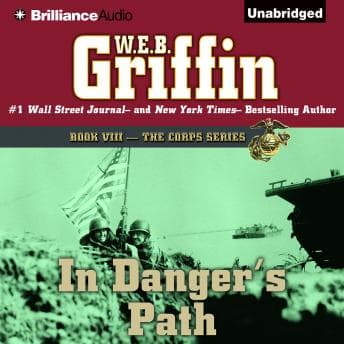
Let me cut to the chase: In Danger's Path is a sprawling, detail-dense WWII novel that rewards patience. If you want nonstop firefights, this isn't your book. If you want to understand how the sausage actually gets made in wartime intelligence operations - the politics, the logistics, the sheer bureaucratic insanity of getting anything done when generals are jockeying for turf - then W.E.B. Griffin delivers.
Twenty-Six Hours in the Gobi and You Won't Mind
Twenty-five hours and fifty-seven minutes. That's a serious commitment. I'll be honest - there are stretches in the middle where Griffin is setting up chess pieces and you're wondering when somebody's going to make a move. But Griffin earned his reputation by understanding something most thriller writers don't: the boring parts of war aren't actually boring if you know what's at stake. The OSS operations in the Gobi Desert, the father-son dynamic between General Fleming Pickering and his scapegrace pilot son Malcolm - these threads take time to develop because real operations take time to develop.
I've seen this scenario play out in real life. You don't just airdrop into hostile territory because someone had a bright idea at a briefing. There are arguments. There are people who think you're insane. There's the guy three pay grades above you who wants to take credit if it works and blame you if it doesn't. Griffin gets all of that right. His military experience - counterintelligence, Army service - shows in ways that matter. Nobody calls a magazine a clip. Nobody makes colonel in six months. The rank structures, the inter-service rivalries between Marines and the OSS, the way Washington politics bleeds into tactical decisions thousands of miles away - the author clearly did their homework, and honestly, he lived it.
The Pick ass-chewing scene that people talk about? It's worth the price of admission by itself. Dick Hill leans into it with exactly the right amount of controlled fury - you can hear the veins popping in the colonel's neck. It's one of those moments where you're grinning alone in the dark because you've been on both sides of that conversation.
Dick Hill Knows What a Command Voice Sounds Like
Dick Hill is one of those narrators who understands military fiction at a cellular level. He doesn't do cartoon voices or melodramatic pauses. His male characters sound like men who've been awake for thirty hours and are making decisions that will get people killed or keep them alive. His pacing matches Griffin's prose - measured, authoritative, occasionally sharp as a bayonet.
At 1.25x, Hill still sounds natural, which is my benchmark for any narrator. Some guys fall apart when you speed them up - their breathing gets weird, their pauses become awkward. Hill handles it fine. Twenty-six hours at normal speed would've been a real test of endurance, but bumped up slightly it moves like a long convoy through friendly territory. Steady, purposeful, and you trust the driver.
I will say this: if you're not already familiar with Griffin's Corps series (this is book eight), you might feel like you walked into a family reunion where everyone knows each other and you're standing by the potato salad wondering who's married to whom. Griffin juggles a LOT of characters across multiple theaters. He catches you up, but it helps to have some history with these people.
Who's Going to Love This - And Who Should Skip It
If you're a Griffin fan, you already own this. If you're a WWII history nerd who likes your fiction thick with operational detail, this is your kind of listening. If you've served and you miss that particular mix of dark humor, institutional frustration, and genuine camaraderie that comes with wearing a uniform - yeah, this hits.
But if you want Jack Reacher pacing or a tight eight-hour thriller, this will feel like a forced march. It's not that kind of book. It's the kind of book that trusts you to pay attention and rewards you for it, but it takes its sweet time getting to the payoff.
Worth your time? Here's the debrief: it's a solid entry in the Corps series, Griffin doing what Griffin does best, and Dick Hill is the right man for the mission. It's not perfect - the middle section could lose three hours and nobody would notice - but when it's firing on all cylinders, particularly the Gobi Desert sequences and the Pickering family dynamics, it's damn good military fiction.
Ranger slept through the bureaucratic chapters and perked up during the operational ones. Dog's got instincts. My wife Linda picked up Where the Crawdads Sing around the same time I was finishing this one - completely different world, but she made the same point about it: the slow build is the whole point, and if you fight it, you lose.