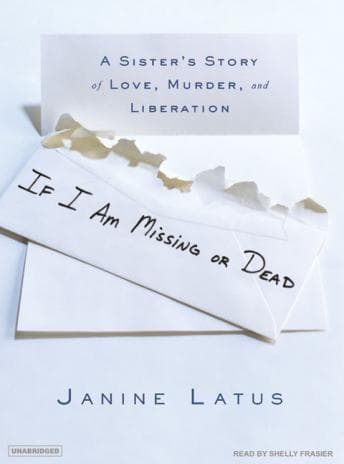

I was walking the lakefront with Denise last Tuesday evening - one of those late spring Chicago nights where the air finally softens and you can smell the lake instead of just hearing it. We'd been quiet for a while, both lost in our own heads, and I had one earbud in listening to Janine Latus describe how her sister Amy taped a note inside her desk drawer predicting her own murder. Denise caught something in my face and asked if I was okay. I wasn't, really. I took the earbud out and we walked the rest of the way home in silence.
This book does that to you.
The Note in the Drawer Changes Everything
Let's talk about what the author is really saying - because the structure here is the argument. Latus doesn't open with her sister's murder and then investigate backward like a true crime podcast. Instead, she braids two timelines: Amy's increasingly dangerous relationship with Ron Ball, and Janine's own history of abusive relationships stretching back decades. And I know some listeners found this frustrating. There's a legitimate criticism that the book spends more time on Janine's story than Amy's, and if you came here expecting a murder investigation, you'll feel cheated.
But here's what I think those critics are missing. Latus is a journalist by training, and this is the most devastating piece of journalism she ever wrote - she just turned the lens on herself. The whole point is the pattern. How two sisters from the same family, smart and successful, both ended up in relationships where they minimized, explained away, and absorbed abuse until it became the background noise of their lives. Amy's note in the drawer - that chilling, clear-eyed prediction - sits in contrast to years of both sisters refusing to name what was happening to them out loud. The gap between knowing and acting is the entire book.
This reminds me of what Hemingway said about writing - that the dignity of movement of an iceberg is due to only one-eighth of it being above water. Latus gives you the surface story, but the weight underneath is about how abuse rewires your sense of what's normal. She traces it back to their childhood, to their father, to the culture of a certain midwestern Catholic family where you didn't talk about these things. You just endured. That excavation of inherited silence reminded me of what Maya Angelou does in I Know Why the Caged Bird Sings — the way trauma gets passed down not through dramatic confession but through everything the family refuses to name out loud.
Shelly Frasier's Flatline Is the Point (Mostly)
Here's where I'm genuinely conflicted. Shelly Frasier reads this in what multiple listeners have called a monotone, and they're not wrong. There's a steady, measured quality to her delivery that doesn't shift much between the moments of terror and the moments of mundane daily life. And at nine hours, that can feel relentless.
But I kept going back and forth on whether this is a flaw or an interpretation. Because that flatness mirrors something real about how survivors describe abuse - this detached, clinical recounting, like they're reading someone else's medical chart. When Frasier narrates Janine describing her husband's control with this almost eerie calm, it sounds exactly like every conversation I've ever had with a student who finally tells you what's happening at home. That careful, emotionless voice. The one that says "I've rehearsed this so many times it doesn't feel like mine anymore."
That said - and this matters - it means there's no relief. No lighter moments where the narration lifts and lets you breathe. By hour six, I genuinely needed a break. I switched to a podcast about baseball for twenty minutes just to recalibrate. The prose deserves to be savored, but your nervous system can only take so much sustained heaviness before it starts to shut down. A narrator who could have found even small moments of warmth in Janine's memories of Amy - the alive Amy, the laughing Amy - would have made those dark stretches hit even harder by contrast.
Who Needs to Hear This (and Who Shouldn't Right Now)
If you've read Joan Didion's "The Year of Magical Thinking" or Mary Karr's "The Liar's Club," this lives in that same neighborhood - memoir as excavation, where the writer digs into family wreckage with a journalist's precision and a sister's guilt. If you loved those, this is their spiritual successor in the domestic violence space.
But I want to be honest: if you're currently in or recently out of an abusive situation, this book could be genuinely triggering. It's not theoretical. It's granular and specific in ways that will land differently depending on your history. And if you want true crime - the investigation, the trial, the forensics - this isn't that book. Ron Ball's sentencing gets maybe fifteen minutes of the nine-hour runtime. The murder is the catalyst, not the subject.
My students would hate this. Too slow, too internal, too much sitting with discomfort. I think that's exactly why it matters.
Worth Pausing the Faculty Meeting For
Janine Latus wrote something brave and imperfect and necessary. The audiobook version asks a lot of you - the monotone delivery means you're doing emotional heavy lifting without much help from the narrator, and nine hours is a long time to spend in that darkness. But the book itself? It's the kind of memoir that changes how you see the quiet couple at the next table. The one where she laughs a little too quickly at his jokes and checks his face before she orders. I listened at 1.0x because the author chose those words, and some of them - especially that note, that terrible prophetic note - deserve to sit in the air a moment before you move on.