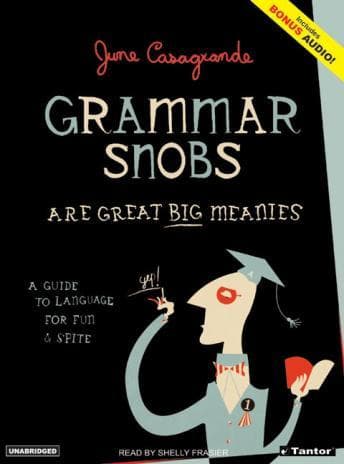

When's the last time someone corrected your grammar and you felt genuinely good about it? Right. Never. That's the entire thesis of June Casagrande's Grammar Snobs Are Great Big Meanies, and honestly, I didn't expect a book about dangling participles to make me feel so psychologically seen.
I was chopping onions for a chana masala — the kind that takes two hours because I refuse to use shortcut pastes, Maa would never forgive me — when I started this one. Five and a half hours later, the masala was done, the kitchen was spotless, and I'd laughed out loud at least four times while alone in my apartment. Which, for a grammar book, is either a miracle or a sign I need to get out more.
The Psychology of the Grammar Bully
Here's what grabbed me as someone who studies why people behave the way they do: Casagrande isn't just teaching grammar. She's doing a psychological autopsy on the grammar snob as a personality type. And she nails it. The grammar snob, as Casagrande frames them, isn't actually motivated by love of language — they're motivated by the need to feel intellectually superior. The protagonist of this book (yes, I'm calling Casagrande a protagonist, fight me) exhibits classic counter-identification patterns: she's a grammar professional who sides with the people grammar professionals typically condescend to.
This is a fascinating case study in authority and insecurity. Casagrande walks through specific "rules" that grammar snobs wield like weapons — the "never split an infinitive" crowd, the "never end a sentence with a preposition" devotees — and shows that these people are often bluffing. They've memorized a handful of prescriptive rules, half of which aren't even real rules, and they deploy them to establish dominance in conversations. The research actually shows that this kind of linguistic gatekeeping maps neatly onto social power dynamics. Casagrande doesn't frame it in those terms, but I found myself asking: why does the grammar snob really correct you? It's not about your comma splice. It's about them. The psychology of needing to perform competence for social status is something Dan Harris accidentally stumbles into in 10% Happier — his whole arc is essentially learning to stop letting his ego run the show, which is exactly what grammar snobs refuse to do.
What makes the book genuinely useful rather than just cathartic is that Casagrande does teach you the actual grammar. She explains the real rules, the fake rules, and the judgment-call-masquerading-as-rules with enough clarity that you walk away more knowledgeable than most of the snobs she's roasting. The essay format — short, punchy chapters rather than a linear textbook structure — keeps it from ever feeling like homework.
Shelly Frasier's Comic Delivery (And One Small Quibble)
Frasier's narration is sharp where it needs to be. Her comic timing carries the self-deprecating humor that's central to Casagrande's voice — there's a difference between reading a joke and landing a joke, and Frasier lands them. The sarcasm comes through without overselling it. She reads with an energy that suggests she's genuinely amused by the material, which helps because grammar humor can go flat fast in the wrong hands.
That said. There's a flatness to the performance in the more instructional passages — the sections where Casagrande shifts from comedy to actual grammatical explanation. Frasier's tone doesn't always differentiate between "here's the punchline" and "here's the lesson," which means some of the educational content blurs together if you're not paying close attention. At 5 hours 30 minutes, this isn't a huge commitment, but I did find my attention drifting during the middle third when the ratio tilted toward instruction over humor. Not a dealbreaker. But noticeable.
Who Should Actually Listen to This
If you've ever been publicly corrected on your grammar and felt that hot flush of shame — yeah, this book is therapy. (My therapist would have thoughts about why I find validation in a grammar book, but here we are.) It's also genuinely good for anyone who wants to understand English grammar without being talked down to.
But if you're looking for a comprehensive grammar reference? Psychologically, this doesn't track as that kind of book. It's a humor book with grammar lessons woven in, not the other way around. People expecting a style guide will be disappointed. People expecting to laugh while accidentally learning the difference between "who" and "whom" — you're in the right place.
Skip it if you already know your grammar cold and don't care about the cultural commentary. The entertainment value depends heavily on recognizing yourself (or someone you know) in Casagrande's descriptions of grammar snob encounters. If you've never been corrected by a pedantic uncle at Thanksgiving dinner, some of the humor won't land.
My Diagnosis: Healthy, With Minor Side Effects
Casagrande understands something fundamental about human nature: people who correct others aren't teaching — they're performing. And she wrote an entire book that's both a takedown of that performance and a genuinely effective grammar lesson. That's a tricky balance, and she mostly pulls it off. Frasier's narration serves the comedy well, stumbles slightly on the pedagogy, and at this runtime, it's the perfect palate cleanser between heavier listens. I ate my chana masala, felt slightly smarter, and didn't hate myself for spending the time. That's a win.