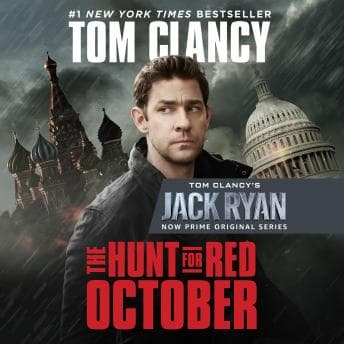

Look, I'll be honest: I came to this audiobook as a behavioral psychologist, not a military tactics enthusiast. Submarines? Cold War posturing? Not exactly my usual fare. But here's the thing about Tom Clancy—the man understood human nature in ways that most thriller writers don't even attempt.
The Psychology of Defection
Captain Ramius isn't just defecting because he's disillusioned with the Soviet system. That would be too simple. Clancy gives us a man grieving his wife, a man whose personal tragedy becomes entangled with political conviction until you can't separate the two anymore. Classic displacement behavior—channeling unbearable grief into an act of such magnitude that it threatens to start World War III. My therapist would have thoughts about this character.
And Jack Ryan? I found myself asking: why does he really get involved? He's an analyst. A desk guy. The research shows that people who voluntarily step into high-risk situations often have something to prove—usually to themselves. Ryan's reluctance reads as genuine, not performative, which is refreshing in a genre full of eager heroes. Clancy understood that real bravery often looks a lot like anxiety with better coping mechanisms.
Scott Brick's World-Weary Voice
I listened to probably twelve hours of this during my morning jogs through Cambridge (yes, all eighteen hours eventually, but the jogs only account for so much). Brick's narration is... interesting. He plays Ryan like a man who's seen too much even when he technically hasn't yet. He brings that same laconic, slightly disillusioned quality to Jurassic Park: A Novel, though there he's narrating chaos of a very different kind. It works beautifully for the character arc we're watching unfold.
His Russian accent adds genuine atmosphere. Not flawless—I've heard native speakers, and this isn't that—but effective. It creates the psychological distance you need to understand these Soviet characters as both adversaries and fully realized humans. The character differentiation is subtle but clear enough that I never lost track of who was speaking, even during the more convoluted submarine sequences.
But. (And there's always a but.) Some stretches feel emotionally flat. There's this fascinating quote I came across where someone described Brick as capable of reading the phone book with all the emotion of losing the love of his life, then coldly describing tragedy in the next scene. Psychologically, this doesn't track as consistent characterization—it's more like the narration occasionally disconnects from the emotional weight of the material. The story carries these moments, but I noticed them.
Also, there's apparently an extra take left in around the 51-minute mark of one chapter. Minor production issue, but once you hear it, you can't unhear it.
Nineteen Hours of Sustained Tension
This is a fascinating case study in slow-burn suspense. Clancy doesn't rush. He builds. The technical details—submarine mechanics, naval protocols, intelligence gathering—could easily become tedious, but they serve a psychological purpose. I noticed similar meticulous world-building in Jurassic Park: A Novel, where the scientific detail actually deepens the tension instead of diluting it. Here, those details create the claustrophobic reality of being trapped underwater with men who might be heroes or might be starting a nuclear war. You feel the weight of every decision because you understand exactly what's at stake.
At nearly nineteen hours, this isn't casual listening. I found myself rewinding sections during cooking (elaborate dishes I'll eat alone, as usual) because the plot threads are genuinely complex. Not convoluted for the sake of complexity—complex because real geopolitical crises are complex. Clancy respects his audience's intelligence, which I appreciate more than I can say.
The pacing works better in audio than I expected. Brick's measured delivery actually helps with comprehension during the more technical passages. I'd recommend 1.0x or maybe 1.1x speed—don't rush this one.
Your Prescription
Best for: Anyone who wants their thrillers to feel earned. If you appreciate character psychology over pure action, if you're interested in Cold War dynamics, if you've got a long commute and want something that demands your attention—this delivers.
Skip if: You need constant action beats. If monotone narration genuinely bothers you (and for some people it does, no judgment). If you're looking for something light.
Case Notes
The Hunt for Red October isn't just a submarine chase. It's a study in loyalty, grief, and the terrifying intimacy of decisions made in isolation. Clancy built something that holds up decades later because he understood that the most dangerous weapon on any vessel is human psychology.
I'm genuinely glad I finally listened to this. Even if my mother would ask why I needed another audiobook when I already have so many.