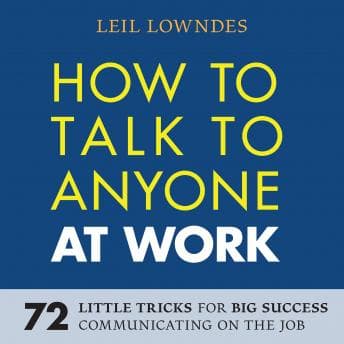

I was prepping slides for a founder pitch at midnight - the kind where you're helping a 26-year-old explain to VCs why his SaaS product isn't just Slack with extra steps - when I figured I'd queue this up. Communication book for the workplace? Sure, let me see if Leil Lowndes has anything my parents didn't figure out running a dry cleaning shop in Koreatown for three decades.
72 Tricks Is About 55 Too Many
Bottom line: There's a solid 90 minutes of genuinely useful workplace communication advice buried inside 6 hours of padding. The 5 Cs framework - Confidence, Caring, Clarity, Credibility, Coexistence - is a decent organizational skeleton. But 72 tricks? That's not a feature. That's a warning sign. By trick number 40, you're getting variations on the same three ideas: mirror people's energy, be specific in your praise, don't email when you're angry. This is what my parents did instinctively. Now it has a TED talk.
The strongest material is in the Coexistence section - the 21 tactics for dealing with toxic bosses and difficult coworkers. That's where Lowndes draws from her 20+ years of consulting, and you can feel the difference between theoretical advice and stuff that's been road-tested in actual conference rooms. She talks about handling a boss who takes credit for your work, and the suggested approach isn't just "document everything" (which, yes, do that), but specific language patterns for redirecting credit in real-time without making it confrontational. I've seen this exact dynamic destroy teams at three different companies. The advice isn't revolutionary, but it's practical and deployable Monday morning.
The Confidence and Caring sections, though? Thinner. A lot of "make eye contact" and "remember people's names" dressed up in new packaging. If you've read any Dale Carnegie - or, honestly, if you've ever worked in a customer-facing role for more than six months - you've already internalized 80% of this. Psychology of Winning in the 21st Century covers similar ground and lands about the same way - competent repackaging of things your grandparents knew, dressed up for people who need a framework before they'll trust their own instincts.
Joyce Bean Does Her Job, But That's the Problem
Here's the narration issue: Lowndes narrated her previous book, How to Talk to Anyone, and she brought a warmth and conversational energy that made the tips feel like advice from a sharp friend at a dinner party. Joyce Bean narrates this one, and she's... professional. Clear enunciation, good pacing, zero vocal fry. But for a book about human connection at work, the delivery lands like a corporate training video. There's this flattened quality to the examples and anecdotes - moments where Lowndes is clearly telling a funny story about a real client situation, and Bean reads it with the same measured cadence she'd use for a terms-of-service agreement.
It's not bad narration. It's just wrong narration for this specific material. A book telling you to be more genuine and emotionally present shouldn't sound like it's being read from a teleprompter. Lowndes herself pops in occasionally - I think for some intro sections - and the contrast is jarring. You hear the author's voice and think, why isn't she doing the whole thing?
The ROI Calculation
At 6 hours 18 minutes, this is mercifully shorter than most business books. At 2.0x speed, you're looking at a little over 3 hours. That's a reasonable investment if you're early in your career and haven't yet developed a framework for workplace communication. If you're mid-career or senior? Skip to the Coexistence chapters - maybe chapters in the back third. The toxic boss material and the sections on navigating office politics when you're the only person in the room who isn't playing games - that's where the real value lives.
The "sweet and short, straight to the point" format works when the tips are strong. Each trick gets an example, a brief explanation, and you move on. No 40-page detours into evolutionary psychology. No "let me tell you about a study at Stanford" filler. When the tips are weak, though, the brevity just makes them feel like fortune cookie wisdom with a business casual dress code.
Jenny would say I'm being harsh. Jenny is right. But Jenny also doesn't sit through three client meetings a week where people who've read books like this still can't give direct feedback without wrapping it in seven layers of "I feel" statements.
Who Gets Value Here (And Who Doesn't)
If you're 2-5 years into your career and still figuring out how to navigate office dynamics without either being a pushover or accidentally burning bridges - this is worth your time. That same early-career navigating-the-terrain audience got something more structurally useful out of Pivot, which at least forces you to think about where you're actually trying to go before optimizing how you talk to people along the way. The 5 Cs framework gives you mental hooks to hang real behavior changes on. If you're a manager or consultant who's been doing this for a decade? The key takeaway is worth the listen. The other 5 hours? Not so much. Borrow it from the library, listen to the Coexistence section, and move on with your life.