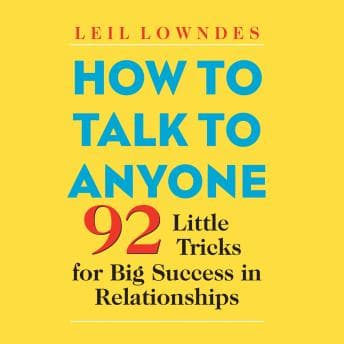

Look, I'm going to be real with you. I picked this up because I have a client—brilliant technical founder, IQ off the charts—who treats networking events like he's navigating a minefield blindfolded. I needed to give him a manual on how to be a human being.
So, I listened to How to Talk to Anyone on a red-eye from SFO to JFK. (Yes, I was the guy in 4C aggressively taking notes on his iPad while everyone else was sleeping. Sleep is for people who haven't hit their Q3 targets.)
The "92 Tricks" Problem (And Solution)
First off, the number. 92. Seriously? Most business books I review are one mediocre idea stretched into ten chapters. Good to Great is one of the rare exceptions—tight, focused, no filler. This is the opposite problem. It's a machine gun of tips.
Leil Lowndes throws everything at the wall. Some of it is pure gold. Some of it is... well, let's just say if I used "The Great Scorecard in the Sky" technique during a McKinsey engagement back in the day, I would've been laughed out of the boardroom.
But here's the thing—it works.
It's tactical. My parents ran a dry cleaner in K-Town for thirty years. They didn't read books on "rapport." They just remembered people's names and asked about their kids. That's tricks #1 through #5 right there. Lowndes just codified the hustle. She gives these techniques cutesy names like "The Flooding Smile" or "Sticky Eyes." (Honestly? "Sticky Eyes" sounds like conjunctivitis, but the actual advice—holding eye contact just a split second longer—is a power move. I tried it on a VC yesterday. It felt weird. He loved it.)
The Voice in Your Ear
Let's talk about Joyce Bean.
I checked the reviews before downloading, and people were complaining she's "monotone" or "robotic."
To those people, I say: You are listening wrong.
When you are consuming a list of 92 instructions, you do not want a narrator acting out Shakespeare. You want clarity. You want a GPS voice. Joyce Bean is that GPS.
I listened at my standard 2.0x speed. At that pace, an overly emotional narrator sounds like a chipmunk having a panic attack. Bean's steady, clear, slightly detached delivery is perfect for high-speed consumption. She sounds like a stern but helpful HR director explaining why you need to stop eating tuna in the breakroom. Her no-nonsense style works just as well in Real Book of Real Estate—turns out her voice is ideal for instructional content across the board. She gets out of the way of the content.
Is she warm? Sure, in a corporate training video kind of way. But for a book that is basically an encyclopedia of social engineering, she nails the tone. Clean. Distinct. No fluff.
The "Fake It 'Til You Make It" Factor
I'll admit, some of this feels manipulative. There are chapters on how to "work a room" that feel a bit like a sociopath's guide to popularity.
But in my line of work—and probably yours, if you're looking at this book—perception is reality.
There's a section on sounding like an insider ("The Scramble Therapy") that basically tells you to learn the jargon of the person you're talking to. Jenny (my wife) calls this "being fake." I call it "client empathy."
The book is dated in spots. It assumes phone calls happen way more than they do in 2024. But the psychology? That hasn't changed.
Who Should Listen (And Who Should Skip)
If you're a technical founder, consultant, or anyone who's ever been told they "come across cold" in meetings—this is your playbook. Skip it if you're already the person everyone gravitates toward at conferences. You don't need 92 tricks; you're already running the room.
Bottom Line
You don't need to memorize all 92 tricks. That's insane. I bookmarked maybe 12 that I'm actually going to use.
Treat this audiobook like a buffet. Grab the lobster (the body language stuff is legit), skip the stale rolls (the weird phone tactics), and get out.
My client? I sent him the book. He's currently practicing his "Flooding Smile." He looks slightly unhinged, but he just closed his seed round. So, ROI achieved.