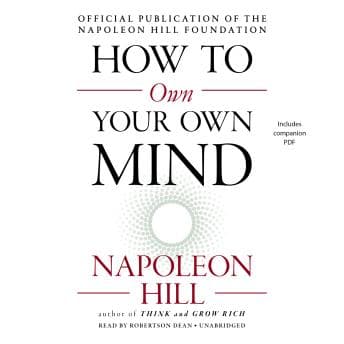

Look, I have a bone to pick with the "lost manuscript" trope. Usually, when a publisher claims a book was "locked in a vault for 80 years," it means the author threw it in the trash because it wasn't good enough, and the estate is just trying to squeeze a few more dollars out of the legacy. I went into this expecting the literary equivalent of reheated leftovers. I had some of that same defensive skepticism with Think and Grow Rich, because Hill’s reputation has been photocopied so many times it starts to look like a motivational ransom note. I was scrubbing my kitchen floor at the time—procrastinating on a paper about narrative identity in adolescents—and I fully intended to hate-listen to this while bleaching the grout.
But here we are. I'm not hating it. In fact, my therapist would probably be annoyed that Napoleon Hill beat her to the punch on a few things.
Robertson Dean and the "Stern Professor" Effect
Robertson Dean is the narrator here, and honestly, he was the only choice. If you hired a chipper, upbeat millennial to read this, the cognitive dissonance would cause a stroke. Dean sounds like the Dean of Admissions at a university you definitely didn't get into. He has this gravelly, authoritative baritone that demands you stop slouching.
There's no character differentiation because there are no characters—this is a lecture. A seven-hour lecture. Dean treats the text with a gravity that borders on religious, which helps mask the fact that the writing can be repetitive. He doesn't try to make it conversational. He leans into the didactic nature of the text. That same graveyard-shift seriousness is exactly why Black Dahlia, Red Rose makes psychological sense in his voice too; Dean narrates pathology like he is calmly labeling jars in a lab. When he delivers the line, "Knowledge is not power. Only applied knowledge is power," he sounds like he's disappointed in your life choices. It worked for me.
1941 Psychology vs. Modern CBT
What surprised me—and I say this as someone who reads academic journals for fun—is how much this overlaps with modern cognitive behavioral strategies. Hill wrote this in 1941, right before the world fell apart, and the anxiety of that era bleeds into the text. He isn't talking about "manifesting" Ferraris like the modern The Secret crowd. He's talking about "Controlled Attention."
Psychologically, he's describing executive function and selective focus. He breaks down how to filter the noise—which, ironic, considering he didn't have to deal with Twitter or TikTok. The structure is dense, broken into three massive chapters rather than bite-sized pieces. It's not designed for the modern attention span, which is exactly why it's irritatingly effective. It forces you to slow down.
The "Maa" Factor
My mother always says, "Priya, you read too much about why people are broken and not enough about how to fix them." She would love this book. It's pragmatic to a fault. There's no fluff, no "just believe and receive." It's about organizing your mind like a filing cabinet.
Be warned though: it is dry. If you're looking for the storytelling flair of a Malcolm Gladwell, you will be bored to tears by hour two. This is a manual, not a narrative. It requires active listening. I found myself having to pause and rewind because I zoned out thinking about my dinner plans, and Dean's voice just became a pleasant, low-frequency drone.
Who This Is (and Isn't) For
Listen if you want practical mental discipline strategies without the woo-woo manifestation nonsense—especially if you respond well to stern, no-excuses delivery. Skip if you need narrative hooks or storytelling to stay engaged; seven hours of lecture format will lose you fast.
Worth Unlocking the Vault?
Actually, yes. It's a reminder that the human brain hasn't changed much in a century. We're still distracted, disorganized, and looking for shortcuts. Hill just tells us to stop looking for them.