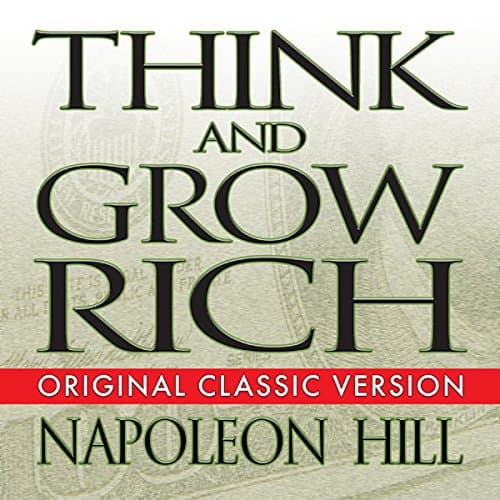

Can we talk about the chapter on sex transmutation for a second? Because I was on a morning jog, minding my own business, earbuds in, and Napoleon Hill just launches into this extended meditation on how sexual energy is secretly the engine of all great achievement. I nearly tripped over a curb. It's 1937, the man is interviewing Rockefeller and Edison, and suddenly we're in territory that makes a modern reader do a double take. That chapter alone earns this book its reputation as one of the strangest, most fascinating self-help texts ever written.
But let me back up. Think and Grow Rich is the granddaddy. The OG. The book that basically invented the motivational speaker industry. If you've ever heard someone talk about visualization, burning desire, or the power of autosuggestion, they're pulling from Napoleon Hill whether they know it or not. This is the 1937 original text — not one of the countless repackaged, modernized, or diluted versions floating around — and hearing it in audio form with Erik Synnestvedt's narration gives it a weight and immediacy that reading the printed page sometimes doesn't.
Hill's core thesis is straightforward: riches begin with a state of mind. He outlines 13 principles — desire, faith, autosuggestion, specialized knowledge, imagination, organized planning, decision, persistence, the master mind, sex transmutation, the subconscious mind, the brain, and the sixth sense — and supports each one with stories drawn from his interviews with over 500 of America's wealthiest and most influential figures. The anecdotes about Ford's stubbornness, Edison's relentless experimentation, and Carnegie's philosophy of accumulation still land with genuine force. These aren't hypothetical success stories. They're drawn from real conversations with real titans.
Now, here's where I have to be honest: this is not a book you can half-listen to while washing dishes. Hill writes in a style that's simultaneously repetitive and dense. He'll hammer the same point from six different angles, which can feel redundant — until you realize that the repetition is the point. He's essentially using the same autosuggestion technique he's teaching you. It's a book that demands you sit with it, turn phrases over in your mind, and actually do the mental exercises he prescribes. The chapter on desire, for instance, doesn't just tell you to want something. It walks you through a six-step process for crystallizing that desire into an obsession so specific that your subconscious can't ignore it.
Synnestvedt's narration is exactly what this material needs. His delivery is measured and warm without tipping into the breathless enthusiasm that plagues so many self-help narrators. He sounds like a thoughtful mentor reading you something important — not a hype man trying to sell you a weekend seminar. There's an authoritative steadiness to his voice that makes Hill's more esoteric ideas (the sixth sense, the invisible counselors technique) feel grounded rather than woo-woo. The audio production is clean and crisp — no music, no sound effects, just one voice and the text. That simplicity works in the book's favor.
Where the audiobook particularly shines is in making Hill's prose feel conversational. On the page, some of his sentences can read as stilted or overly formal for modern tastes. But spoken aloud by Synnestvedt, they carry a natural cadence. The chapters on faith and persistence especially benefit from this treatment — hearing someone articulate the idea that "every adversity carries with it the seed of an equivalent benefit" hits differently when it's spoken with quiet conviction rather than scanned on a page.
Is the book perfect? No. Some of Hill's assumptions about gender and race are products of their era and will make you wince. The promises can feel grandiose — Hill essentially guarantees wealth to anyone who follows his system, which is a claim that doesn't survive contact with reality for everyone. And some concepts, particularly the "master mind" alliance and "infinite intelligence," hover in a gray zone between practical psychology and metaphysical hand-waving. You have to take what serves you and leave the rest.
But here's the thing: nearly ninety years after publication, people are still listening to this book. They're still underlining passages, still building vision boards based on Chapter 2, still forming mastermind groups with friends. That kind of staying power isn't an accident. Hill captured something real about the psychology of achievement — the role of obsessive focus, the danger of indecision, the power of surrounding yourself with people who push you higher. Strip away the dated language and the occasional mystical leap, and you're left with a framework that's remarkably practical. The experience of sitting with a text that demands you interrogate your own assumptions — the way Hill keeps turning the mirror back on you — reminded me oddly of Rachel Held Evans doing the same thing in Searching For Sunday, a completely different genre and conversation, but that same unsettling quality of a book that refuses to let you stay comfortable where you are.
At nine and a half hours, it's a substantial listen that rewards multiple passes. I found myself restarting certain chapters immediately after finishing them — particularly the sections on organized planning and decision — because the ideas needed time to settle. This isn't background audio. It's a book that asks something of you, and Synnestvedt's narration makes that ask feel less like homework and more like a conversation worth having.
Who Should Listen (And Who Should Skip)
If you're curious about the origins of the self-help genre, or if you want a framework for thinking about goal-setting that goes deeper than most modern productivity books dare to, this is essential listening. Skip it if you need your advice scrubbed of early-twentieth-century attitudes and mystical asides — Hill won't meet you there, and the frustration will outweigh the insight.