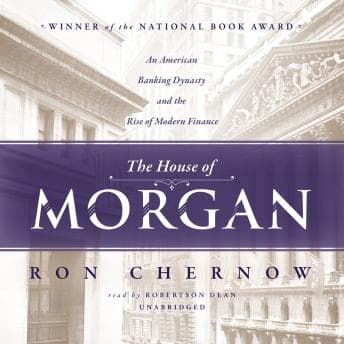

Ron Chernow doesn't write books. He constructs monuments. The House of Morgan is exactly that—a 34-hour monument to American capitalism, built brick by meticulous brick from Victorian London to the crash of 1987.
This is the definitive account of how one family shaped modern finance. Four generations of Morgans, the secretive firms they built, and the world they bent to their will. Chernow won the National Book Award for this, and after spending weeks with Robertson Dean's narration in my ears, I understand why. The research is staggering. The access to family archives and business records shows on every page. This isn't pop history dressed up in a suit—it's the real thing.
Dean's narration carries this massive work with remarkable steadiness. His voice is clean and professional, with careful pacing that respects the material's weight. He brings a certain dignity to the proceedings without tipping into stuffiness. When you're dealing with figures like J.P. Morgan—men who could trigger financial panics or prevent them depending on their mood—you need a narrator who understands gravitas. Dean delivers.
But here's where I have to be honest with you. This audiobook is a commitment. At nearly 35 hours, you're signing up for a long-term relationship with 19th and 20th century banking. The first half crackles with energy—the rise of the Morgan empire, the backroom deals, the personalities who could make or break nations. The founding era material is genuinely thrilling stuff. You feel the power these men wielded when governments came to them hat in hand.
Then comes the 1929 crash. And something shifts.
The later sections, covering the post-Depression era through the 1980s, lose momentum. The regulatory environment changes. The colorful titans give way to more bureaucratic figures. Some listeners have described these final stretches as genuinely boring, and I won't pretend they're wrong. The magic of the early Morgan era—that sense of watching titans walk the earth—fades into something more corporate and less compelling.
Dean faces another challenge: the sheer number of characters. We're talking about 150 years of history across two continents, with countless bankers, politicians, and power brokers cycling through. No narrator could make every voice distinct, and Dean doesn't try. He wisely focuses on clarity and forward momentum rather than theatrical character work. It's the right choice for this material, even if it means you'll occasionally lose track of which Morgan associate is speaking.
The production quality is spotless. Clean audio, professional throughout, no technical distractions. This matters when you're asking someone to spend a week of their life with an audiobook.
Compared to Chernow's other biographical works—his Hamilton or his Rockefeller—The House of Morgan is broader in scope but perhaps less intimate. That single-subject focus is what makes Prince so compelling—you're locked into one artist's singular vision rather than tracking generations of power. Here, you're not following one man's life but an institution's evolution. It's more like a history of American power itself, told through the lens of one extraordinarily influential family. If you loved Titan (Chernow's Rockefeller biography), you'll find similar DNA here, though stretched across a wider canvas.
Who This Is (and Isn't) For
MBA students, absolutely. Anyone who wants to understand how modern finance actually developed rather than accepting it as some natural phenomenon. History buffs who can handle density. Long-haul commuters who want something substantial to chew on over weeks of driving. If you're fascinated by the intersection of money and power—how private bankers once held more sway than elected officials—this is essential listening.
Skip it if you need your history served with constant drama and cliffhangers. If detailed explanations of financial instruments make your eyes glaze over. If 34 hours sounds like a prison sentence rather than an opportunity, trust that instinct.
I'd recommend listening at 1.25x speed for most sections. Dean's measured pace benefits from a slight acceleration, and it'll help you power through the slower later chapters without losing comprehension.
Worth the Investment?
The House of Morgan remains a classic for good reason. It's the book that explains why the financial world works the way it does—or doesn't. Chernow's research is unimpeachable, Dean's narration is reliably excellent, and the early sections deliver genuine historical drama. Just know what you're signing up for. This is a marathon, not a sprint, and the final miles are harder than the first.