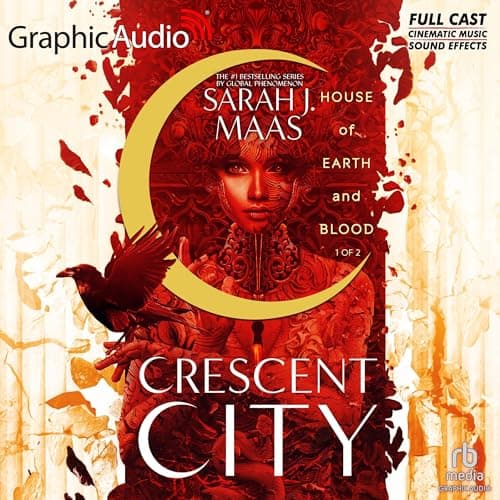
"Bryce Quinlan had the perfect life—working hard all day and partying all night—until a demon murdered her closest friends."
That setup hit me somewhere around the fifteen-minute mark, and I realized this wasn't going to be the breezy urban fantasy romp I'd expected from the Crescent City hype. Sarah J. Maas built something darker here, something with real weight behind the glitter and nightclubs.
Let me be upfront about what this is: a dramatized adaptation with a full cast of over thirty actors, cinematic scoring, and sound effects designed to make you feel like you're walking through Crescent City yourself. I listened to most of this during evening sessions at my desk, headphones on, lights low—and that turned out to be exactly the right call. This is not a casual listen. When sirens blare and car horns honk during city scenes, they sound real enough to make you check your rearview mirror. Multiple listeners have reported nearly swerving off the road, and I believe every one of them.
The production from Graphic Audio is ambitious. Colleen Delany brings a sharp-edged vulnerability to Bryce that captures both her party-girl exterior and the grief she's barely holding together underneath. The chemistry between Bryce and Hunt Athalar builds slowly—this is Part 1 of 2, remember—so if you're coming from ACOTAR expecting immediate heat, recalibrate your expectations. The slow burn is deliberate, and the murder investigation that drives the plot gives the story a procedural backbone that Maas's other series don't really have. The layered world-building here actually reminded me of the faction-heavy complexity I appreciated in Fell Sword, where keeping track of competing political hierarchies is half the pleasure.
What works exceptionally well is the worldbuilding. Crescent City is dense—angels, Fae, shifters, demons, and humans all stacked on top of each other in a modern metropolis with its own politics, hierarchies, and criminal underworld. Think of it like a D&D campaign setting where someone crammed five sourcebooks into one city and somehow made it all function. In a standard audiobook, this much exposition can feel like homework. The dramatized format actually helps here because different voices anchor different factions, making it easier to track who belongs where. When Hunt's storyline weaves in, you feel the tonal shift through his voice actor's delivery alone. Danny Montooth and Nick J. Russo both bring distinct energy to their roles, and the ensemble approach means you're never stuck with a single narrator trying to voice forty characters.
But here's where I have to be honest about the trade-offs. The cinematic music sometimes oversells emotional moments that would hit harder with silence. During violent scenes, the sound effects veer into territory that feels gratuitous—wet, crunchy, lingering longer than necessary. A few quieter character moments get undercut by background ambiance that sounds like it was pulled from a stock library. One listener called the whole thing "cheesy," and while I wouldn't go that far, I understand the impulse. There's a line between immersive and overproduced, and this adaptation occasionally stumbles across it.
The pacing issue deserves its own mention. This is Part 1 of a split adaptation of a book that's already famously slow in its first half. Maas takes her time establishing Crescent City and its inhabitants, and if you're not hooked by the mystery or invested in Bryce's grief, those first several hours can feel like wading through quicksand. I found the investigative thread compelling enough to carry me through the worldbuilding dumps, but your patience may vary.
A few voices in the cast struck me as slightly flat—not robotic exactly, but lacking the naturalistic quality of the strongest performers. In a cast this large, that's almost inevitable, and the standouts more than compensate. Delany's Bryce is the anchor, and she holds it.
What surprised me most was how the story's emotional core—Bryce processing the murder of her best friend Danika—actually landed harder in this format. Hearing her voice crack, hearing the silence after a revelation, hearing the city sounds continue indifferently around her grief—that's something a page can't do. The dramatized format earns its existence in those moments.
Is this the definitive way to experience House of Earth and Blood? That depends entirely on how you feel about audio drama as a format. If you've enjoyed Graphic Audio's other adaptations or love the idea of a full-cast production with genuine cinematic ambitions, this delivers. If you prefer a single narrator who lets your imagination do the heavy lifting, or if you mostly listen while multitasking, this will frustrate you. It demands your full attention, and it rewards that attention about seventy percent of the time.
For a story this complex, being split into two parts actually works. You get the setup, the worldbuilding, the initial investigation, and the first real sparks between Bryce and Hunt without feeling like you're sprinting through six hundred pages. It ends at a point that makes you want Part 2 immediately, which is exactly what a good first half should do.
Who Should Listen (And Who Should Skip): If you love dense, faction-heavy fantasy worldbuilding and want something that plays more like a cinematic experience than a traditional audiobook, queue this up. If you need fast pacing, prefer a single-narrator format, or mostly listen while doing other things, skip it—this one punishes divided attention.