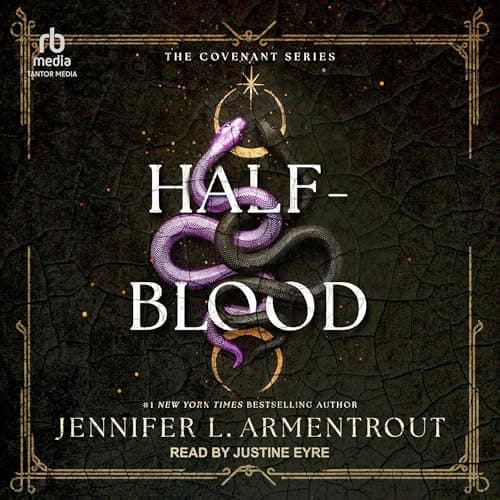

Okay, can we talk about the elephant in the room? Half-Blood reads like someone took Vampire Academy, swapped vampires for Greek mythology, and hit ctrl+C, ctrl+V on the entire social hierarchy. Half-bloods vs. pure-bloods? Dhampirs vs. Moroi? A fierce, mouthy heroine who'd rather fight than serve? A forbidden romance with the older, brooding mentor? I spent the first couple hours of this audiobook playing a mental drinking game every time I spotted a parallel, and let me tell you, I would not have survived with actual drinks.
But here's the thing — and this is where I have to eat a little crow — I still had a great time listening to it. Because even if the framework feels borrowed, Jennifer L. Armentrout knows how to write characters you want to root for, and Justine Eyre knows how to make you care about them through your earbuds.
Let's start with Alex, our seventeen-year-old half-blood protagonist. She's impulsive, sarcastic, and has the self-preservation instincts of a lemming with a death wish. She should be annoying. On paper, she probably is annoying. But Eyre gives her this breathless, stubborn energy that makes you lean into the chaos instead of rolling your eyes at it. When Alex is being reckless, you feel the adrenaline. When she's vulnerable, Eyre dials it back just enough to sell the emotion without making it melodramatic. It's genuinely good voice acting.
The world Armentrout builds here draws heavily from Greek mythology — the Hematoi are descendants of gods and mortals, daimons are essentially corrupted pure-bloods feeding on aether, and the Covenant is this training academy where half-bloods learn to be Sentinels. The class system is rigid and uncomfortable in a way that gives the story actual stakes beyond the romance. That kind of social stratification with real teeth is something Tower of Dawn does brilliantly too, though in a much grimmer register. Half-bloods who don't make the cut as Sentinels become servants — and "servant" here is a generous euphemism. The book doesn't shy away from how messed up that is, and it gives Alex's determination to succeed real weight.
Aiden, the pure-blood love interest, is exactly the kind of stoic, noble, impossibly attractive guardian figure that this genre demands. Eyre differentiates him well vocally — his scenes have this restrained warmth that contrasts nicely with Alex's chaotic energy. Their chemistry works, even if you can predict every beat of the forbidden romance from orbit. The tension between what they want and what the rules allow creates some genuinely charged moments.
Then there's Seth, the Apollyon, who shows up and throws a wrench into everything. The connection scenes between Alex and Seth are some of the more interesting parts of the audiobook because they hint at something larger and more complex than a straightforward love triangle. Eyre handles the shifting dynamic between these characters with real skill, making each relationship feel distinct.
Pacing-wise, the book has some uneven stretches. The training montage sections in the middle drag a bit, and there are moments where the exposition about Covenant rules and Hematoi politics feels like someone reading a fantasy wiki page out loud. At nine hours and change, it's not an enormous time commitment, but I'd be lying if I said every minute earned its keep.
What keeps it moving is Armentrout's talent for plot twists that land with genuine impact. Just when you think you've got the story figured out, she drops a revelation about Alex's heritage or powers that recontextualizes what came before. These moments are where Eyre really shines — her delivery on the big reveals carries real emotional punch.
The production itself is clean and standard — no music, no sound effects, just Eyre and the story. That's perfectly fine here because her performance doesn't need embellishment. She's an Audie Award winner for a reason, and while this particular book isn't her most challenging work, she elevates material that could easily feel derivative into something genuinely entertaining.
Who Should Listen (And Who Should Skip)
If you've read Vampire Academy and you're going to spend the whole time mentally checking off similarities, this might frustrate you more than it rewards you. Skip it, or at least go in eyes open. But if you can accept the familiar framework, enjoy the Greek mythology spin Armentrout puts on it, and you're in the mood for a scrappy heroine making terrible decisions — there's real fun to be had here. Alex is the kind of protagonist who makes you want to keep listening just to see what reckless thing she does next, and Eyre makes sure you feel every bit of it.
This is a solid entry point into a series that, from what I understand, gets stronger as it goes. Institute: A Novel gave me that same first-book feeling — a protagonist trapped inside a system designed to use them, with just enough mystery seeded in to make the sequel feel genuinely necessary rather than commercially inevitable. The foundation is laid well enough that I'm curious where things go with Seth, with Alex's emerging powers, and with the class tensions that simmer beneath the romance. It's YA paranormal comfort food, well-prepared and well-served.