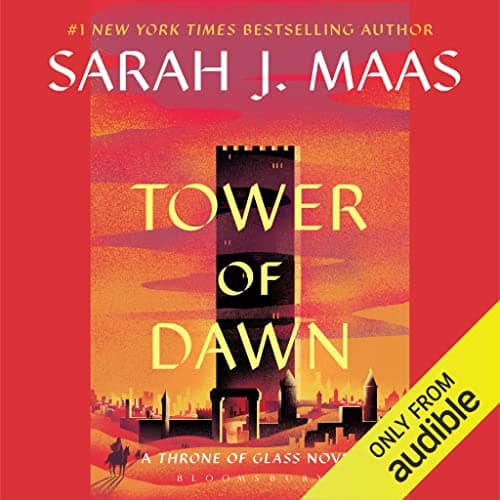
Tower of Dawn is the book that almost nobody asked for but many ended up grateful exists. When Sarah J. Maas announced that Chaol Westfall—a character who'd become increasingly divisive among fans—would get his own full-length novel set on a different continent, the collective groan was audible. But here's the thing: this might be the most emotionally mature entry in the entire Throne of Glass series.
Let me be upfront. I came into this audiobook skeptical. Chaol had worn out his welcome with me somewhere around Heir of Fire, and the idea of spending twenty-two hours away from Aelin, Rowan, and the main war felt like homework. Elizabeth Evans changed that calculus entirely. Her narration is the engine that pulls you through the slower stretches, and there are slower stretches—make no mistake. But Evans voices Chaol's frustration, his grief, his stubbornness with such conviction that you stop resisting and start caring again. One listener put it perfectly: her performance has always been the main motivational reason to keep picking up these books in audio.
The story follows Chaol and Nesryn Faliq as they travel to Antica, the seat of the southern continent's empire, ostensibly to heal Chaol's broken body and forge a military alliance. What unfolds is really two parallel stories. Chaol works with Yrene Towers, a healer from the Torre Cesme whose backstory connects to earlier events in ways that feel earned rather than contrived. Nesryn, meanwhile, gets pulled into the world of the rukhin—warriors who ride giant birds called ruks—and uncovers a threat that reshapes everything we thought we knew about the series' central conflict.
Yrene is the revelation here. She's fierce, principled, and refuses to coddle Chaol through his recovery. Their dynamic crackles with tension, both romantic and ideological. The healing scenes double as psychological excavation—Yrene doesn't just mend his spine, she forces him to confront every failure, every betrayal, every choice he's been running from. It's the redemption arc Chaol desperately needed, and Maas writes it with a patience she doesn't always display. Evans handles these emotionally dense chapters with real skill, modulating between Chaol's resistance and his slow, painful openness.
Nesryn's storyline is the one that delivers the worldbuilding punch. Antica feels genuinely different from Adarlan and the northern kingdoms—the politics, the culture, the architecture all come through in Maas's descriptions. The rukhin are a highlight, giving the series its most distinctive military culture since the Fae. And Sartaq, the prince Nesryn becomes entangled with, is a welcome addition to the cast. Their romance develops more organically than some of Maas's pairings, probably because it has room to breathe.
Here's where I have to be honest about the pacing. At over twenty-two hours, this audiobook demands commitment. The middle section meanders. Political negotiations repeat similar beats. There are stretches where you'll wonder when the plot will snap back into gear. I listened to most of this during focused evening sessions, and I'd caution against treating it as background audio—the character work requires your attention, and if you're half-listening while doing dishes, you'll lose the thread and then lose patience.
The back third, though, is where everything converges. The revelations about the Valg, the connections to the wider war, the emotional payoffs for both Chaol and Nesryn—it hits hard. That slow-burn structural patience—where an author makes you feel the weight of every earlier scene paying off at once—is something Last Argument of Kings does with brutal, devastating efficiency, and it's rare enough that I notice when any fantasy series pulls it off. You realize that what felt like a detour was actually Maas laying essential groundwork. Readers who skipped this book and went straight to Kingdom of Ash reportedly felt lost, and I believe it.
Evans maintains strong character differentiation throughout. She doesn't do wildly distinct voices for every character, but her emotional register shifts convincingly between Chaol's brooding intensity, Yrene's sharp warmth, and Nesryn's quiet determination. No audio quality issues to report—the production is clean from start to finish.
The book's weakness is also its strength: it's a character study disguised as an epic fantasy installment. If you're coming off the momentum of Queen of Shadows or Empire of Storms expecting wall-to-wall action and Aelin's fire-breathing theatrics, Tower of Dawn will feel like a cold shower. But if you let it work on its own terms, it delivers something the series hadn't managed before—genuine emotional complexity for a character who'd been flattening into a one-note obstacle. Listen if you're invested in the Throne of Glass series and willing to sit with a slower pace for a real payoff. Skip if you need constant action or have zero attachment to Chaol—twenty-two hours is a lot to spend on a character you actively dislike.
Is it essential? For the series, absolutely. As a standalone listening experience, it's a slow burn that rewards patience. Evans makes the journey worth taking even when the destination feels far away.