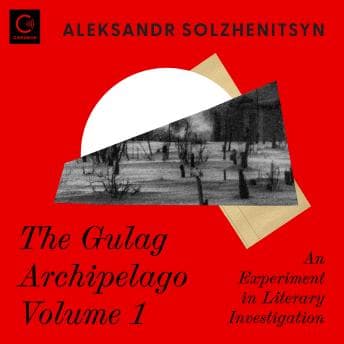

Twenty-six hours is a long time to spend with any book. Twenty-six hours with Solzhenitsyn's account of Soviet state terror is something else entirely.
I started this on a Saturday morning walk along the lakefront with Denise. By the time we got back to the apartment, I was quiet in a way she recognized. She asked if I was okay. I told her I was listening to a man describe how the secret police would arrest people at dentist appointments, in hospital beds, on their wedding days - and how the system was designed so that every single Soviet citizen could be made guilty of something. She didn't ask me to switch to music. She just let me be quiet.
The Architecture of a Machine Built to Swallow People
Let's talk about what Solzhenitsyn is really doing here, because calling this "nonfiction" doesn't capture it. This is Volume 1, which covers the arrest and interrogation machinery - the intake system of the Gulag. And Solzhenitsyn approaches it like a scholar, a survivor, and - this is what gets you - a darkly funny man who refuses to let bureaucratic evil be boring. He catalogs thirty-one methods of psychological torture used during interrogation, and he does it with the precision of someone who endured them and the bitter wit of someone who decided the best revenge was documentation.
The scope is staggering. This isn't one man's prison memoir. Solzhenitsyn collected testimony from 227 fellow prisoners and wove their experiences together with Soviet legal history, his own arrest as a Red Army captain in 1945, and a forensic dismantling of every justification the Soviet state ever offered. He traces the system back before Stalin, back to Lenin, which was the part that truly shattered the Western left when this book appeared in 1973. This reminds me of what Hemingway said about writing - the dignity of movement of an iceberg is due to only one-eighth of it being above water. Except Solzhenitsyn drags the whole iceberg up and forces you to look.
The book is dense. I won't pretend otherwise. There are chapters on Soviet criminal code articles that read like a legal textbook, and sections where Solzhenitsyn traces institutional lineage through decades of bureaucratic evolution. My students would hate this. I love it. But I'd be lying if I said every hour of those twenty-six was equally gripping. Some passages demand you rewind and listen again, not because they're beautiful but because the information is so layered you can't process it in a single pass.
Frederick Davidson and the Problem of Reading Horror Aloud
Frederick Davidson, RADA-trained, approaches this the way a British radio dramatist would - measured, controlled, with real attention to Solzhenitsyn's tonal shifts. And those shifts matter enormously. Solzhenitsyn moves from savage irony to statistical analysis to raw grief, sometimes within a single paragraph. Davidson catches the irony. When Solzhenitsyn describes the absurdity of interrogators working in shifts to exhaust a prisoner who isn't allowed to sleep - treating it almost like a factory production problem - Davidson's delivery has this dry, almost amused quality that mirrors the author's own disbelief at the banality of it all.
But here's the split: some sections feel choppy. Davidson's pacing occasionally breaks the flow of Solzhenitsyn's longer rhetorical passages, where the prose builds and builds toward a devastating point. The narrator understands that pause is punctuation - but sometimes the pauses land in odd places, fragmenting sentences that need momentum. It's not a dealbreaker. It's a friction point, especially in the middle hours when the material itself is already demanding your full concentration.
I listened at 1.0x. The prose deserves to be savored, even when - especially when - what it describes is unbearable. Speeding this up would feel wrong, like fast-forwarding through testimony.
Who Needs to Hear This (And Who Should Prepare Themselves)
If you loved Applebaum's Gulag: A History, this is its spiritual ancestor - the firsthand account that made her academic study necessary and possible. If you've read Primo Levi on the Holocaust and understood that bearing witness is its own form of resistance, Solzhenitsyn is doing something parallel but on an industrial national scale.
This is not casual listening. I tried it during grading at 11 PM one night and had to stop - not because I was tired but because I was reading a sophomore's essay about The Great Gatsby while listening to a description of prisoners packed into transit cells so tightly they took turns breathing, and the cognitive dissonance almost broke me.
You need dedicated time. Quiet. A willingness to sit with information that will genuinely change how you understand the twentieth century.
Worth Pausing the Faculty Meeting For
This is why we still read the classics - because some books aren't just literature, they're evidence. Solzhenitsyn wrote this knowing it could get him killed, smuggled it out of the Soviet Union on microfilm, and the world that received it was never quite the same. Twenty-six hours is a commitment. It should be. The people whose stories fill these pages gave a lot more than twenty-six hours. The least we can do is listen. The only other narrator experience this year that made me feel similarly obligated to pay full attention was Fellowship of the Ring — a completely different world, obviously, but Rob Inglis brought that same sense of weight to Tolkien's prose that Davidson brings here at his best.