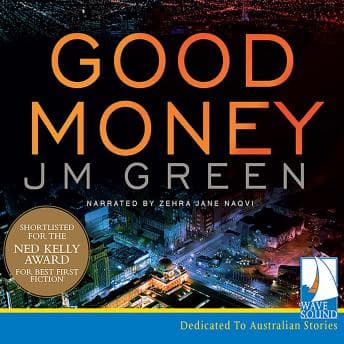

Was not expecting to get hooked on Australian crime fiction at 2 AM while prepping a threat assessment for a logistics client, but here we are. Good Money grabbed me by the collar early and didn't really let go until somewhere around hour eight — and even then, I was still leaning in.
Let me cut to the chase: this is a solid debut crime novel set in Melbourne's western suburbs, and it's doing something I don't see enough in the genre. Stella Hardy isn't a cop, isn't ex-military, isn't an FBI profiler with a tragic backstory and a drinking problem (well, she might have the drinking part). She's a social worker. Burned out, running low on give-a-damn, and operating in that messy gray zone where the justice system meets actual human suffering. That's a fresh angle, and J.M. Green makes it work.
Melbourne's West Side Is Its Own Character
The setting here is what sold me. Green writes Melbourne's western suburbs — Footscray, specifically — like someone who's walked those streets, smelled the pho shops, and knows exactly which alley you don't cut through after dark. The murdered African boy in the opening isn't just a plot device; the book actually digs into the immigrant communities, the casual racism they face, the way institutional neglect creates vacuums that drug dealers are happy to fill. I've seen this scenario play out in real life — different country, different specifics, but the mechanics of how vulnerable populations get exploited? Universal.
Stella stumbles onto something connected to her own past while trying to comfort the dead boy's mother, and that personal thread keeps the stakes from becoming abstract. She's not saving the world. She's trying to make sense of one terrible thing that connects to another terrible thing, and the web just keeps spreading — drug dealers, sociopaths, structural corruption. That layered sense of institutional rot bleeding into personal stakes reminded me of House on Vesper Sands — different era entirely, but the same feeling that the system itself is part of the crime. The author clearly did their homework on how social services actually operate, and the procedural details around Stella's work feel authentic in a way that a lot of crime fiction misses. It's not glamorous. It's paperwork and phone calls and showing up to apartments that smell like despair.
Naqvi Carries the Australian Grit
Zehra Jane Naqvi handles narration duties here, and I'll be honest — I went in with zero expectations because I'd never heard her work before. She's good. Not going to change your life, but she nails the dry Australian humor that Green threads throughout what is otherwise pretty dark material. Stella's internal monologue has this sardonic, self-deprecating edge, and Naqvi delivers it with the right amount of fatigue and wit. You believe this is a woman who's seen too much and still can't stop herself from caring.
Where it gets a little flat is in the male voices. The drug dealers and cops tend to blend together — I lost track of who was speaking a couple of times during group scenes. Phuong Nguyen, Stella's police contact and (clearly) love interest, comes through more distinctly, which matters because that relationship is one of the book's quiet strengths. But the villain differentiation? Could've been sharper. At 1.25x the pacing felt right — Naqvi's natural tempo runs a touch slow for my taste at normal speed.
This Is Where It Lost Me (Briefly)
Around the midpoint, there's a stretch where Stella makes a series of decisions that had me talking back to my truck speakers. Look — I get it, characters in crime novels need to put themselves in danger for the plot to move. But there's a scene where she essentially walks into a known drug house alone, at night, with zero backup and no plan beyond "I'll figure it out." I've briefed enough corporate executives on personal security to know that even civilians understand you don't do that. Green tries to justify it through Stella's emotional state, and it half-works, but it pulled me out of the story for a good twenty minutes.
The book recovers, though. The final act tightens up considerably, and the connection between the murdered boy and Stella's past revelation lands with real weight. Not everything gets wrapped up neatly — this is book one of a series, and it shows — but the central mystery resolves satisfactorily.
Who's This Mission For?
If you like your crime fiction street-level and socially aware — think more Tana French's community dynamics than Lee Child's one-man-army approach — this'll work for you. Fans of Australian crime (Peter Temple, anyone?) will feel right at home. If you need constant action or military-grade tactical sequences, this isn't your book. The violence here is ugly and brief, which is actually more realistic than most thrillers get.
Skip it if bad character decisions in crime novels make you throw things. You've been warned.
Ranger's Debrief
Worth your time? Here's the debrief: Good Money is a strong series opener with genuine social consciousness, a protagonist who earns your investment through flaws rather than competence, and a setting that feels lived-in rather than researched. Naqvi's narration carries it well enough, even if she's not going to win any awards for voice differentiation. I'll be picking up the sequel. Ranger slept through the middle section, but he perked up for the ending. That tracks.