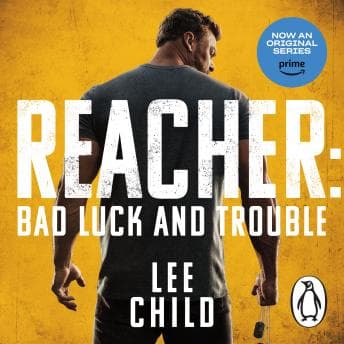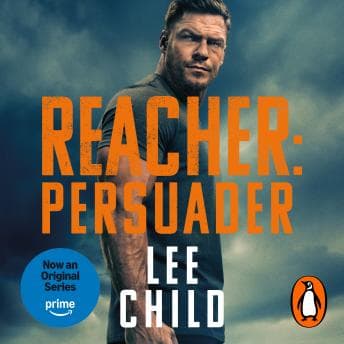

I was chopping onions for a chana masala at eleven on a Tuesday night — one of those elaborate solo cooking sessions I do when my brain won't stop running — and the opening of this book genuinely made me set the knife down. Lee Child opens with Reacher sitting on a late-night subway car, mentally running through the twelve signs of a suicide bomber on the passengers around him. It's clinical. It's procedural. And it's absolutely the kind of thing a former military cop would actually do, which is what hooked me. The protagonist exhibits classic hypervigilance patterns, but Child frames it not as pathology but as competence. That's a deliberate psychological choice, and I found myself asking: why does Reacher really keep cataloging threats in a world where he's chosen to be a drifter with no obligations?
The Twelve-Point Checklist and the Illusion of Control
The suicide bomber checklist that opens the book — and that Reacher recites almost like a mantra — is a fascinating case study in how people use procedural knowledge as emotional armor. Reacher doesn't feel fear in this scene. He feels certainty. He's got his list, he's got his training, and the woman on the subway who triggers five of the twelve indicators becomes a problem to solve rather than a person to understand. This is where Child is actually smarter than people give him credit for. The entire book is about what happens when Reacher's certainty turns out to be both right and catastrophically wrong at the same time. The woman, Susan Mark, is a government operative carrying secrets that multiple agencies want buried, and her death in the opening chapters sets off a chain of conspiracy that pulls in federal agents, local cops, and shadowy political operatives.
What makes this character compelling is that Reacher spends the whole book trying to understand Susan Mark after he can no longer ask her questions. He's reconstructing a dead woman's psychology from fragments — which, honestly, is what half my research involves, except I use fictional characters and he uses apartment leases and phone records.
But here's where I got annoyed. The conspiracy itself — involving a politician's secrets, a cover-up, and layers of government involvement — follows such a predictable escalation pattern that by hour eight I was mostly listening to confirm what I'd already guessed rather than to discover anything new. Piranha runs into similar territory — that same confident procedural momentum carrying you past a plot you've already mapped out in your head. The research actually shows that thriller readers tolerate predictable plots if the protagonist's problem-solving process is satisfying to watch. And it is, mostly. Child writes Reacher's logical deductions with such confident simplicity that you keep going. But the villains? Psychologically, this doesn't track. They're interchangeable threatening men who exist to be obstacles, not people. My therapist would have thoughts about these characters — specifically, that they don't have enough interiority to have thoughts.
Jeff Harding's Reacher Problem
Jeff Harding narrates with a steady British baritone that works well for Reacher's internal monologue — that flat, declarative, almost affectless voice suits a man who processes the world through tactical assessment rather than emotion. Where it gets tricky is the pacing. Harding reads action sequences at roughly the same tempo as exposition, which means a scene where Reacher is calmly eating a diner breakfast and a scene where he's physically fighting his way out of a trap land with almost identical energy. For a 13-hour listen, that lack of dynamic range starts to flatten things out.
His character differentiation is functional but basic — you can tell who's speaking, but the federal agents and military types all share a similar clipped delivery that makes them blur together. The female characters get slightly softer intonation but not much else. Honestly, for a book that's fundamentally a one-man show, it works well enough. Reacher is the only person who truly matters here, and Harding gets his voice right: tired, intelligent, dangerous, and oddly polite.
Who's Going to Love This (And Who Won't)
If you're thirteen books deep into the Reacher series, you already know what you're getting and you probably want it. This is comfort food thriller territory — the pleasure is in watching a supremely competent man navigate a situation where everyone else is either lying, incompetent, or both. If you're looking for complex character psychology or villains with genuine motivations beyond "they're powerful and corrupt"... this isn't it. And I say that as someone who genuinely enjoyed the ride while simultaneously being frustrated by the wasted potential of Susan Mark's backstory, which could've been a real exploration of institutional pressure and moral compromise but instead gets reduced to a plot mechanism.
The first-person narration is a departure for Child — most Reacher books are third person — and it's interesting to live inside Reacher's head, but it also exposes how much this character runs on certainty and how little on doubt. That makes him fun. It also makes him a bit shallow.
My Case Notes
I finished the chana masala and the audiobook within two days of each other. The masala was better — more complexity, more layers. But the audiobook did exactly what it promised: kept me locked in during late-night cooking and a Saturday morning of grading papers I'd been avoiding. Sometimes you don't need a character study. Sometimes you need a guy who can identify a suicide bomber on the subway and then spend thirteen hours proving he was right. Just don't come to this expecting anyone besides Reacher to feel like a real person.