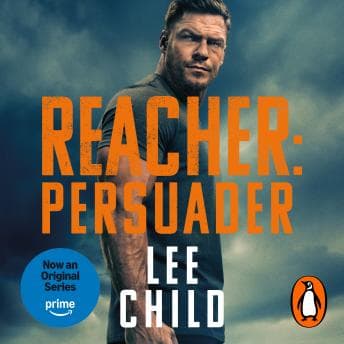

What makes a good guy do bad things?
That's the question I kept turning over during my drive home from the trauma center at 4 AM, the Arizona desert dark outside my windows and Jeff Harding's voice filling my car with Jack Reacher's particular brand of moral calculus. A cop dies in this one. And Reacher's not exactly broken up about it. Which should've bothered me more than it did.
Post-Shift Decompression, Reacher Style
Look, I've been listening to Reacher books for years now—they're perfect for that post-shift decompression when my brain is still buzzing from whatever chaos the ER threw at me but I'm too tired to process anything complicated. Persuader hit different, though. There's this whole revenge subplot woven through the main story that goes back to Reacher's military days, and honestly? After 15 years of watching people at their worst and their best in trauma situations, I get it. Some things you don't let go of. Some wrongs demand righting even when the path there is messy. That same moral ambiguity drives Housekeeper: A twisted psychological thriller, though the stakes are more intimate and the tension even more claustrophobic.
The kidnapping setup at the beginning pulls you in fast—Reacher witnesses an attempted abduction and just... inserts himself into the situation. Classic Reacher. But then he's undercover with some seriously bad people, and the tension doesn't let up for fourteen hours. I missed my turn twice. Carlos texted asking if I'd fallen asleep at the wheel. I had not. I was just really invested in whether Reacher was going to blow his cover.
Jeff Harding Gets Reacher (Mostly)
Okay, so here's where I have to be honest. Jeff Harding's narration is polarizing and I understand why. His voice is gritty, smooth, laid-back in a way that captures Reacher's whole "I'm a 6'5" killing machine who just wants to drink coffee and mind my own business" vibe perfectly. The man nails the character. When Reacher's doing his tactical thinking—explaining how he's going to take down three armed men with a paperclip and bad intentions—Harding makes you believe every word.
But. And this is a real but. He does this thing where sentences end the same way? Like there's a pattern to his delivery that my brain started noticing around hour five. It's not a dealbreaker—clearly, since I finished all fourteen hours—but I can see how it would drive some people up the wall. My sister-in-law borrowed my Audible login once and she lasted twenty minutes before texting me "how do you listen to this man." Different strokes.
The emotional moments land, though. There's a scene involving Reacher's past that Harding delivers with this quiet intensity that had me gripping my steering wheel in the hospital parking garage like an idiot. The range from casual conversation to hard-hitting confrontation is solid. Scattering had that same kind of narrator who could shift emotional gears on a dime—essential when the story keeps you guessing. I've heard some people prefer Dick Hill for the American editions, and I get it, but Harding's become the voice in my head for these books.
The Medical Stuff (Because You Knew I'd Mention It)
There's violence in this book. A lot of it. And here's the thing—Lee Child doesn't shy away from the aftermath. When people get hurt, they stay hurt. When Reacher takes damage, he feels it. As someone who's actually worked a code, who's seen what bullets and blunt force trauma actually do to human bodies, I appreciate that Child doesn't just have characters walk off injuries that would have real people in the ICU for weeks.
Is it perfectly medically accurate? No. (That's not how adrenaline works, sir, I yelled at my dashboard at least once.) But it's close enough that I wasn't thrown out of the story, and honestly that's all I ask. The pacing is relentless—this isn't a slow burn, it's a sustained high heat that matches the adrenaline of a busy shift. Perfect for keeping me awake on the 45-minute drive home.
Who's This For?
If you want a thriller that doesn't let up, moral complexity that actually feels earned, and you can handle Harding's particular cadence—this one's for you. Skip it if you need your heroes squeaky clean or if repetitive vocal patterns make you twitchy. Also maybe not ideal if graphic violence pulls you out of a story.
Clocking Out
Already planning a relisten. This is one of those books where knowing the ending doesn't diminish the ride—if anything, I want to go back and catch the foreshadowing I missed. The dual timeline structure (present-day undercover operation plus flashbacks to Reacher's military past) works surprisingly well in audio format. I thought I'd get confused, but Harding differentiates them clearly.
Carlos asked why I sat in the driveway for ten minutes after I got home. I blamed the ending. He's used to it by now.
Night shift approved. Just maybe bump the speed to 1.25x if Harding's pacing starts feeling repetitive—it helped me through the middle sections.