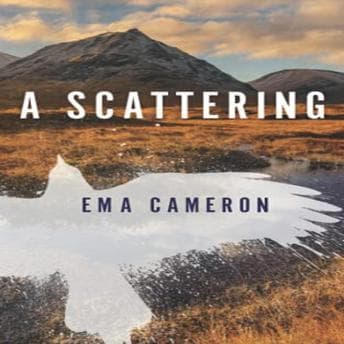

Look, I've been teaching Scottish literature for two decades, and I can count on one hand the number of audiobooks that actually get the Highlands right. Most of them sound like Americans doing bad Braveheart impressions. So when I hit play on Scattering during my usual lakefront walk with Denise, I was bracing myself for disappointment.
I was wrong. Wonderfully, completely wrong.
When the Voice Becomes the Landscape
Eilidh Beaton's narration isn't just good—it's the kind of performance that makes you understand why oral tradition mattered. This is a woman who sounds like she grew up hearing these stories, not like she studied them in a studio. The Gaelic phrases don't feel like foreign intrusions; they feel like the natural music of the text. And honestly? That's rare. That's the thing you can't fake.
The story itself weaves between 1850s Highland Scotland and a contemporary artist named Rose who's picking through the ruins of both an abandoned landscape and her own fractured family. It's a dual-timeline structure that could easily feel gimmicky, but Cameron uses it to ask something I find myself asking my students all the time: What do we inherit from the people who came before us? Not just genetically. Emotionally. The silences we carry. The songs we remember without knowing why.
Catrìona's sections hit harder than I expected. The Highland Clearances—that brutal period when landlords evicted entire communities to make room for sheep—isn't exactly beach reading material. Beneath a Scarlet Sky tackles a similar weight—ordinary people caught in historical brutality—though it trades Scottish moors for wartime Italy. But Cameron doesn't turn it into a history lesson. She makes you feel what it means to watch your world scatter. The musicality of seasons and Gaelic tunes that opens the book becomes something fragile, something you know is about to break.
The Slow Burn That Pays Off
I'll be honest—this isn't a page-turner in the thriller sense. If you need plot twists every twenty minutes, you're going to get restless. I almost did, somewhere around hour two, grading papers at 11 PM and wondering if Rose's modern storyline was going to earn its place.
It does. Patience pays.
The contemporary sections feel deliberately fragmented at first, mirroring Rose's own restlessness and her struggle to make sense of her family history. But Cameron is building something. The connections between past and present don't arrive as dramatic revelations—they accumulate like sediment. By the time I finished, walking the lakefront again (Denise had given up on me being present for conversation), I understood why the structure had to work this way.
Beaton's pacing suits this perfectly. She doesn't rush the emotional moments, but she doesn't wallow either. There's a confidence to her delivery that reminds me of the best audiobook narrators—the ones who trust the material enough to let silence do some of the work. My students would probably say it's too slow. They'd be wrong. (Don't tell them I said that.)
What the Author Is Really Saying
At its heart, Scattering is about what survives displacement. Not just physical displacement—the Clearances, the emigration, the loss of land—but the emotional kind. The way trauma echoes through generations. The way we try to piece together stories from fragments.
Cameron has a background in visual arts, and you can feel it. Rose's sections have this quality of someone examining a landscape, looking for meaning in ruins. It's the same impulse that drives historians, that drives anyone who's ever tried to understand where they came from. I spent a good chunk of my doctoral work on exactly this kind of literary archaeology, and Cameron gets it right.
The prose deserves to be savored. I listened at 1.0x—obviously—and I'm glad I did. There are sentences here that would lose their music at faster speeds. The rhythm of Gaelic phrases woven through English, the way Beaton shifts her delivery between timelines... you'd miss half of it at 1.5x.
Would I Assign This to My Students?
Probably not. They'd complain about the pacing, and I'd have to explain the Clearances, and someone would inevitably ask why we can't just read something "fun." But I'd recommend it to the handful who actually care about literature—the ones who stay after class to ask about Faulkner, who might actually listen to my podcast.
This is the kind of book that reminds me why I still do this. Why I still believe that stories matter, that the way we tell them matters. Beaton's narration elevates already strong material into something genuinely moving.
Worth pausing the faculty meeting for. Definitely worth the walk.









