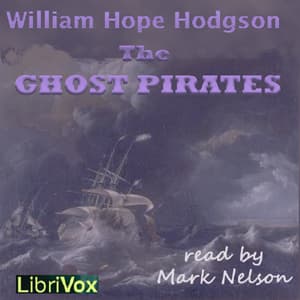

So here's the thing everyone gets wrong about William Hope Hodgson: they call him "Lovecraft before Lovecraft" and move on. That's lazy. Hodgson was a sailor. He knew the Atlantic the way Lovecraft knew his Providence study - which is to say, one of them actually lived inside the horror they wrote about. The Ghost Pirates is the proof.
I pulled this one up on a rainy Tuesday night, shelving returns at the library after hours. The branch was empty, the rain was doing that Oregon thing where it sounds like fingers tapping on every window simultaneously, and I thought, "Perfect. Maritime horror. Let's go." Five hours later I was sitting in the dark parking lot in my car because I'd finished it and didn't want to walk to my door in the rain. Not because I was scared, exactly. Because the mood hadn't let go yet.
The Ship That Swallows You Whole
This book is under five hours. That matters. Hodgson doesn't waste a single nautical term - and there are many - on filler. The premise is deceptively simple: a sailor named Dodd joins the crew of the Dodd's ship the Dodd - wait, no. Jessop. Jessop joins the crew of the Dodd - sorry, the Dodd - okay, I'm going to be honest, the ship name and some character names blurred on me because Hodgson writes in this dense, period-accurate sailor's vernacular that demands your full attention. But the feel of this book? Unshakable. The ship is being gradually overtaken by translucent, quasi-human figures that climb the rigging, appear in the shadows, and drag the vessel toward something unknowable. The first sighting of these ghost-things - where Jessop spots a figure on the side of the hull that shouldn't be there - is pure slow-burn dread. No jump scare. No gore. Just wrongness. Shirley Jackson walked so this author could... well, Hodgson actually walked first, publishing this in 1909. Jackson would've loved it. That slow wrongness without a single drop of blood is something I tracked in a completely different register when I reviewed Giving Up The Ghost - shorter, more contemporary, but it knows the same secret Hodgson knew: the thing you almost see is worse than the thing you do.
This understands that horror isn't about gore - it's about dread. The sea-devils don't announce themselves with thunder and lightning. They seep in. One figure becomes two becomes an infestation, and the crew's growing terror mirrors yours. The commandeering of the ship happens so gradually that by the time you realize how bad things have gotten, it's too late. For the crew. For you.
Mark Nelson: The Polarizing Quarterdeck
Okay. Here's where I need to be honest, because the listener community is split on this narrator and I understand both sides.
Mark Nelson has a voice built for maritime fiction. Low, weathered, authoritative - when he's reading Jessop's matter-of-fact descriptions of shipboard life, it works. He sounds like a man who's actually hauled rope and stood watch. His delivery of the crew's frightened dialogue - the "sea dogs" muttering about what they've seen - has a grounded quality that keeps the supernatural elements from tipping into camp.
But.
When the horror peaks - when the ship is being pulled under, when men are dying - Nelson doesn't always shift gears. There's a flatness that creeps in during moments that should make your stomach drop. The climax of this book is apocalyptic in its implications, and the narration treats it with roughly the same energy as the rigging descriptions in chapter two. I wouldn't call it robotic, exactly, but I'd call it restrained to the point where it undercuts Hodgson's best moments. The narrator commits... halfway. And halfway isn't enough when ghost pirates are dragging your ship into oblivion.
I'd put him at a solid but frustrating middle ground. He elevates the atmosphere but mutes the terror.
Who Should Brave These Waters
If you're into classic horror - actual classic, not "classic" meaning 1985 - this is essential listening. Hodgson's influence on cosmic horror, on the idea that the ocean hides intelligences we can't comprehend, is enormous. You can draw a direct line from this book to later maritime horror in film and fiction.
But fair warning: the nautical jargon is thick. Braces, halyards, fo'c'sle, mizzen - Hodgson doesn't translate for landlubbers. I'd recommend 1x speed and actual focus. This is not a background-while-doing-dishes listen. You zone out for three minutes and suddenly you've lost the geography of the ship, which means you've lost the horror.
If you scare easily, you'll be fine with the narration dampening things. If you don't scare easily, you'll wish Nelson had pushed harder. Either way, the source material is strong enough to carry you through.
Shirley (my cat) was unimpressed. I was unsettled in that slow, deep-tissue way that only pre-WWI horror manages.
The Log Entry
Finally, horror that respects the genre - or at least, the text does. The performance is a mixed bag that'll divide listeners. But The Ghost Pirates at under five hours is a lean, relentless haunting that earns its place in the canon. My podcast listeners are going to love arguing about this one. I listened in the dark. Mistake? Maybe. Worth it? Absolutely. Even with a narrator who occasionally sounds like he's reading the ship's manifest instead of its death warrant.