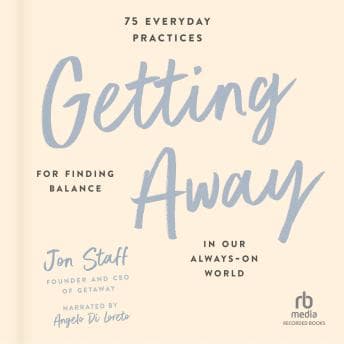

"Spend at least 30 minutes outside daily."
That's one of the 75 practices in this book. I read that line - heard it, technically, at 2.0x while meal-prepping Sunday bulgogi for the week - and I thought about my mom. She spent 14 hours a day inside a dry cleaning shop in Koreatown. No windows worth mentioning. If you'd told her to spend 30 minutes outside daily, she would've laughed and handed you a shirt to press.
This is the fundamental tension of Getting Away, and Jon Staff never quite reckons with it.
75 Practices, Maybe 12 That Earn Their Spot
Look, I get what Staff is doing. He built Getaway - the tiny cabin company where you drive two hours out of the city, lock your phone in a box, and pretend you're Thoreau for 48 hours. It's a good business. I respect the hustle. And this book is the lifestyle extension of that brand: 75 bite-sized practices for unplugging without, you know, actually unplugging.
Some of them land. The practice around designing a "phone-free zone" in your home is specific enough to be useful. The chapter on writing handwritten notes to people you care about - that one hit me, because my dad used to leave notes for customers with their cleaned suits, little thank-yous in shaky English. He didn't need a book to tell him that human connection matters. But I can see how someone grinding through their third year at a Series B startup might need the reminder.
The problem is the ratio. Seventy-five practices is a lot. And when you're stacking "surprise someone with a small gift" next to "strike up a conversation with a stranger" next to "take a walk," you start feeling like you're reading a wellness blog that got a book deal. Which - and I mean this respectfully - is basically what happened. Staff founded a company, the company has a philosophy, and the philosophy got stretched into a book. I've seen this playbook at McKinsey a hundred times. Thought leadership as marketing. It's not evil. It's just not always worth 7 hours of your life. Jenny Mitchell's take on Pivot wrestled with the same tension—when does a founder's philosophy earn the full book treatment versus a well-crafted blog post?
The Narrator Does His Job. That's About It.
Angelo Di Loreto reads this with the calm, measured energy of a meditation app instructor who's had exactly the right amount of coffee. It's fine. It's pleasant. It's the audio equivalent of a Getaway cabin - clean, functional, nothing that's going to surprise you. For a book that's essentially a list of lifestyle suggestions with supporting anecdotes, the narration doesn't need to do heavy lifting, and it doesn't try to. No complaints, but nothing that made me think "this performance is adding something the text doesn't."
At 7 hours and 16 minutes, this could've been 3 hours, easy. Each practice follows the same structure: here's the idea, here's why it matters, here's how to try it. That repetition works if you're dipping in and out over a few weeks. It's brutal on a continuous listen, even at 2x. My 2.0x speed couldn't save this one - not because it's bad, but because the format fights the medium. This is a reference book pretending to be a narrative.
The Privilege Problem Nobody's Talking About
Here's where I get honest. The one listener review I found called this book "loved" and praised how each practice has "easy ways to try it out." And sure, if you're a knowledge worker with flexible hours and disposable income, these practices are easy. Take a bath. Go for a hike. Leave work early once a week.
But Staff barely acknowledges that his target audience is pretty narrow. The dry cleaner, the line cook, the home health aide working doubles - they don't get to "design a phone-free morning routine." Their morning routine is designed by their second job. This is what my parents did instinctively - the few practices here that actually matter, like being present with family, showing up for your community - they did those without a framework or a cabin rental company. Now it has a TED talk.
I don't need every self-help book to solve structural inequality. But a single chapter acknowledging that "balance" is a luxury would've gone a long way.
Who Gets the ROI
If you're a burned-out tech worker or consultant (I see you) who genuinely hasn't considered that you could, like, eat lunch without your laptop open - there's value here. Pick 5-10 practices that speak to you, skip the rest. If you're someone who already journals, walks, and occasionally touches grass, you're not going to find anything new.
Jenny would say I'm being harsh. Jenny is right. But she'd also say this book would've been better as a podcast series, and she'd be right about that too.
The Consulting Memo Version
Bottom line: Getting Away is a decent collection of wellness micro-habits packaged as a book-length brand extension. The key takeaway is worth the listen. The other 7 hours? Not so much. Skip around, cherry-pick what fits your life, and don't feel guilty about not finishing it. I certainly won't be.