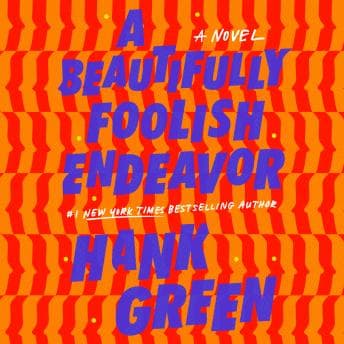

"How do we find comfort in an increasingly isolated world?" That question hit me around hour six, while I was adjusting kerning on a logo that my client would inevitably hate, and I had to stop. Just stop. Hands off the keyboard, Frida staring at me from the windowsill like I'd lost it. Because Hank Green wasn't asking that question academically - he was asking it like someone who's been doom-scrolling at 2 AM and realized the phone is holding him hostage. And I felt that in my chest.
The Book That Made Me Text My Group Chat at Midnight
So here's the thing about A Beautifully Foolish Endeavor - it's technically a sci-fi sequel about alien robots called the Carls, but what it actually is? It's a book about what happens to the people left behind after the world-changing event. After April May dies (or... does she?), her friends are scattered in their grief. Andy's performing aliveness on conference stages. Maya's spiraling into obsession because standing still means feeling the loss. Miranda's chasing science that could break reality. And the way these storylines braid together isn't neat or tidy - it's messy the way real grief makes people messy.
I came into this having listened to An Absolutely Remarkable Thing last year and honestly? This one goes harder. The first book was about becoming famous overnight and losing yourself. This one is about what it costs to save the world when the world doesn't even know it needs saving. Green gets into these questions about consciousness, about a force that literally wants to consume human attention and free will, and - listen, I'm a designer, not a philosopher, but when the book started exploring how we trade our autonomy for comfort and connection, I had to pause and stare at my own screen time report. Brutal.
The emotional core, though, is April's absence and eventual return. Without spoiling too much, there's a thread about choosing to come back to your people even when you've been somewhere bigger, somewhere beyond human understanding, and the grief of knowing you can never fully explain where you've been. That hit different. Abuela would have understood that one - the idea that love is the thing that pulls you back to the small, imperfect world.
Twelve Narrators Walk Into a Booth
Okay, TWELVE narrators. Twelve! This is ambitious bordering on chaotic, and somehow it works. Each character gets their own voice actor, so when the POV shifts from Andy to Maya to Miranda to Carl (yes, the alien entity gets a narrator), you feel the tonal shift immediately. It's like channel-surfing between people's interior lives.
Kristen Sieh carries a lot of the emotional weight as April, and she handles the weird balance of someone who's been transformed by an alien intelligence but is still, at her core, a messy twenty-something from New York. Joe Hempel as Andy nails that performative confidence covering deep insecurity - you can hear him trying too hard, which is exactly the point. And Hank Green narrating as Carl? There's something genuinely eerie about the author voicing the inhuman consciousness in his own book. It shouldn't work but it does - his delivery is flat and measured in a way that feels intentionally alien against all these emotionally raw human voices.
The transitions between narrators can be jarring if you're half-listening. This is not a background book. I tried to keep designing during some of the denser sections about the "Space" (this virtual reality-adjacent world the antagonist creates) and had to rewind twice because I'd missed crucial plot mechanics while color-correcting photos. When the book wants your full attention, it demands it.
When the Sci-Fi Becomes a Mirror
What got me - what really got me, crying session number one at approximately hour eleven - is that this book written in 2020 predicted so much about how we'd surrender our attention to algorithms and curated realities. There's a corporation in this book offering people a perfect virtual world, and people choose it over their actual messy lives, and Green doesn't judge them for it. He understands the appeal. He just asks: what are you giving up? And who profits from your surrender?
I ugly-cried at the ending. Not because it's sad - it's actually weirdly hopeful - but because it earns its hope. These characters fight for each other, fumble, make terrible decisions, and still choose connection over comfort. My heart. MY HEART. That same gut-punch of characters choosing each other despite impossible circumstances runs through Five Little Indians, though it earns its tears in a completely different way.
Is it perfect? No. The pacing in the middle third drags when it gets into the mechanics of the books-that-predict-the-future subplot - there's a lot of "here's how the mystery works" that could've been tighter. And some of the corporate villain stuff felt a little too on-the-nose, like Green wanted to make absolutely sure you Got The Point about tech monopolies. I got it, Hank. I got it three chapters ago.
But those are small complaints against a book that made me feel seen in my anxiety about the internet while also making me believe we might figure it out.
Who Needs This in Their Ears
If you loved the first book, this is bigger, weirder, and more emotionally devastating. If you haven't read An Absolutely Remarkable Thing, go do that first - this won't land without it. If you want romance, this isn't it, but the love between these friends is its own kind of love story. If you need your sci-fi hard and technical, this might frustrate you. But if you want a book that feels like a long conversation about what it means to be human when the world is trying to optimize you into content? This book felt like that conversation.
This is a rainy Sunday book. Clear your schedule. Tell your cats to fend for themselves. Pay attention.