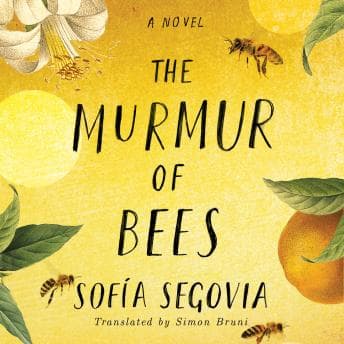

What happens when a country tears itself apart and a family puts their faith in a child who speaks to bees?
I've been teaching magical realism for two decades now—García Márquez, Allende, the usual suspects—and I'll admit I approached Sofía Segovia's novel with that particular skepticism English teachers develop. Another Latin American epic with supernatural elements? But here's the thing. Fourteen hours later, walking the lakefront with Denise while the final chapters played, I found myself stopping mid-stride. Just standing there. The joggers probably thought I was having some kind of episode.
When History Becomes Personal
Segovia does something I try to explain to my juniors every year but rarely see executed this well: she makes the Mexican Revolution and the 1918 influenza epidemic feel intimate. Not textbook intimate. Kitchen-table intimate. The Morales family's world is crumbling—land reform threatening their livelihood, disease sweeping through Linares, violence lurking at the edges—and yet the narrative never loses its human scale.
Simonopio, this strange foundling covered in bees, becomes the lens through which we see everything. And look, I was worried this would veer into precious territory. Magical children in literature can go very wrong very fast. Nine Perfect Strangers had me worried the same way—high-concept premise that could've collapsed into gimmick—but like Segovia, Moriarty trusted her characters enough to let them be human first. (My students still haven't forgiven me for assigning that one Rushdie novel.) Segovia keeps Simonopio grounded. He's not a symbol. He's a kid who happens to see things others can't, and the family's response to him—the fear, the love, the fierce protection—feels earned.
The dual timeline threw me at first. We're getting the story through old Francisco's memories, decades later, and that frame narrative adds this layer of melancholy that just sits with you. It reminds me of what Hemingway said about the iceberg theory—so much is happening beneath the surface of what's actually being told.
Two Voices, Two Eras
Angelo Di Loreto's narration is why I'm writing this review instead of just quietly recommending the book to my book club. His voice has this warmth that feels like someone's grandfather telling you the important family stories—the ones that matter, the ones you need to carry forward. The pacing is deliberate without dragging, which is harder than it sounds. He understands that pause is punctuation.
Xe Sands handles the present-day framing sections, and the contrast works. Some listeners apparently found the dual narrator choice odd, but I think it reinforces the time-split in the narrative. Different eras, different voices. Made sense to me.
I listened at 1.0x because—and my students roll their eyes at this—the prose deserves to be savored. Segovia's sentences have a rhythm that gets lost if you speed through them. The translation (by Simon Bruni) maintains something lyrical in the language that Di Loreto clearly respects. He's not just reading words. He's interpreting them.
Where the Narrative Breathes
I'll be honest: there's a stretch in the middle where the pacing slows. The setup of the family dynamics, the land, the community—it takes its time. I was grading sophomore essays during one of these sections and found my attention splitting. But here's what I realized later: those slower moments are doing work. Segovia is building a world you'll need to care about when things start breaking.
And they do break. The influenza sequences are haunting in a way that hits differently now than they would have pre-2020. The violence of the Revolution seeps in gradually, then suddenly. The book earned its Audie Award.
Who This Is For (And Who Should Skip)
If you loved One Hundred Years of Solitude, this is its spiritual successor. Different country, different magic, but the same understanding that family sagas are really about how we carry our dead with us. If you need fast pacing and constant action, the deliberate middle section will test your patience—my juniors would complain about the length, say it's slow, miss half the symbolism with the bees. But if you're willing to let a story unfold at its own pace, this one rewards you.
The audiobook format genuinely enhances this one. Di Loreto's emotional delivery during the key revelations—I won't spoil them, but you'll know them when you hear them—elevated moments that might have landed differently on the page. Worth pausing the faculty meeting for. (Principal Martinez, if you're reading this, I was definitely paying attention to the curriculum updates. I wasn't. I was in 1918 Mexico.)
Class Dismissed
Fourteen hours is a commitment. But I finished it three days ago and I'm still thinking about those bees.