
How many times have you rewritten a Slack message to your manager because you were afraid of their reaction - and then wondered if you were the problem?
I started this book on a Wednesday morning commute, half-caffeinated, scrolling through a group chat where a friend was asking if she was "overreacting" to her partner dismissing her feelings. Again. By the time I got to Mountain View, I'd already texted her "STOP. I'm sending you a book."
The Debug Log for Your Relationships
TL;DR: Worth your commute, but maybe not in the way you expect.
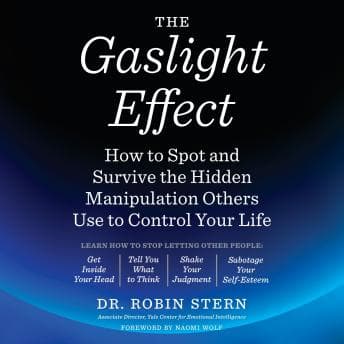
Dr. Robin Stern basically wrote a diagnostic manual for a specific type of emotional manipulation, and the framework she lays out - the three stages of gaslighting (disbelief, defense, depression) - is genuinely useful. It's like she gave you grep patterns for toxic communication. The early chapters hit hard because Stern loads them with these composite case studies: the husband who flirts openly at dinner then calls his wife "controlling" when she objects, the boss who greenlights your project in private then publicly shreds your judgment. Each scenario is specific enough that you'll either recognize someone in your life or - and this is the uncomfortable part - recognize yourself as the one doing it.
What surprised me is that Stern doesn't paint gaslighters as cartoon villains. She spends real time on the "Gaslight Tango" - the idea that you're an active participant, not just a passive victim. Some reviewers hated this. They felt she wasn't strong enough about calling out abuse. I get that criticism, but I actually think it's the book's strength. She's not writing for people who already know they're being abused. She's writing for people who are still in the "Am I crazy?" phase, and meeting them there requires some gentleness.
The ROI on this audiobook is high if you're in that questioning phase. Less so if you need an action plan for leaving a dangerous situation - this isn't that book.
Where the Architecture Gets Shaky
Here's the thing - at nearly 10 hours, this could've been trimmed. Not quite "could've been a blog post" territory, but there are stretches in the middle where Stern cycles through variations of the same dynamic (romantic partner gaslighting, boss gaslighting, parent gaslighting) and the examples start to blur. By hour 6, I was bumping up to 1.75x because I'd already internalized the pattern and was waiting for the toolkit sections.
The practical advice - her "Opting Out" strategies and the "Power Statements" you can use to disengage from a gaslighting conversation - those are genuinely good. Concrete, memorable, usable. But they come late. If you're a skip-to-the-actionable-parts person (hi, that's me), you'll be antsy getting there.
Nan McNamara's narration is... fine. Clean, professional, no weird pronunciation issues. But for a book about emotional manipulation, I wanted more tonal variation in the case study sections. When she's reading a gaslighter's dialogue versus the victim's internal monologue, they sound pretty similar. It doesn't kill the experience, but a narrator who could inject some of that subtle condescension into the gaslighter's lines would've made the examples land harder. You'd feel the manipulation instead of just understanding it intellectually.
Who Needs This in Their Queue
Perfect for: commute, housework. Skip for: bedtime (this will keep you up analyzing every relationship you've ever had).
If you're someone who constantly second-guesses yourself in relationships - romantic, professional, family - this gives you a vocabulary for what's happening. That alone is valuable. I've been a software engineer long enough to know that you can't fix a bug you can't name, and Stern is basically giving you the error taxonomy. On the flip side of that emotional vocabulary work, Cry Like a Man tackles the specific ways men are taught to suppress and mislabel their emotions — different angle, same core idea that naming the thing is step one.
Skip this if you're already well-read on emotional abuse dynamics - Lundy Bancroft's Why Does He Do That? covers adjacent territory with more intensity. And if you're in an actively dangerous situation, this book's somewhat academic tone might frustrate you.
But for that friend in my group chat? The one who keeps asking if she's "too sensitive"? This is exactly the book. I finished it in 4 commutes at 1.5x, and the framework has already changed how I talk to her about what she's going through.
(Kevin, if you're reading this - no, I'm not gaslighting you about whose turn it is to do dishes. That's just regular disagreement.)
Ship It, With Caveats
Solid self-help audiobook that does one thing well: it names the pattern. The narration won't blow you away, the middle section drags, and some listeners will want it to be angrier on behalf of victims. But the core framework is genuinely useful, and at 1.5x speed, it's a reasonable time investment for potentially life-changing awareness. Worth a credit if you need it. You'll know within the first hour if you do.