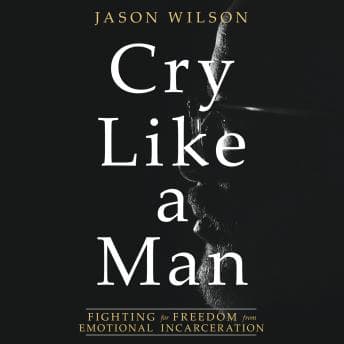

I have a confession. I almost didn't finish this audiobook—not because it wasn't good, but because Jason Wilson kept describing emotional patterns I've spent years studying in clinical literature, and hearing them narrated with such raw honesty felt like being called out personally. My therapist would have thoughts about why that made me uncomfortable.
Here's the thing that frustrated me in the best way: Wilson doesn't give you the sanitized, self-help version of masculinity and trauma. He opens with his grandfather's lynching. His brothers' murders. A father who was there but wasn't *there*. And I kept thinking—this is a case study I would assign to my graduate students, except it's not clinical. It's a man standing in front of you saying "this is what broke me, and this is how I'm still putting pieces back together."
The Protagonist Exhibits Classic Avoidant Patterns (And Knows It)
What makes Wilson compelling as a narrator of his own story is his psychological self-awareness without the academic distance. He describes what I would clinically call "emotional suppression as survival mechanism" but he calls it "emotional incarceration"—and honestly? His metaphor lands harder than my jargon ever could.
The research shows that men who experience early paternal absence develop specific defensive structures around vulnerability. Wilson doesn't cite studies. He doesn't need to. He just describes watching himself become the thing he feared—emotionally unavailable, rage-prone, performing masculinity like armor—and you understand the pattern because you're watching him live it.
I found myself asking: why does Wilson's story feel different from the dozens of "men need to cry" books I've encountered? I think it's because he doesn't position himself as fixed. He's not selling you a transformation complete. He's showing you the ongoing work.
Damany Jackson Understands the Assignment
The narrator choice here matters enormously. Jackson delivers Wilson's most vulnerable moments—describing his father wounds, his marriage struggles, his moments of breaking—with this quality I can only describe as earned intimacy. There's weight in his voice during the heavy sections without tipping into melodrama.
I was listening during one of my late-night cooking sessions (daal makhani, if you're curious, the kind that takes three hours and nobody but me will eat), and there was this section about Wilson teaching young boys in Detroit to process anger. Jackson's delivery shifted—became almost instructional but still warm. You could hear the difference between Wilson-the-wounded-man and Wilson-the-healer. That's not easy to pull off.
No pronunciation issues. No weird audio artifacts. Just clean, emotionally intelligent narration.
Where the Therapist in Me Got Skeptical
I won't pretend the faith-based framework works for everyone. Wilson's healing journey is explicitly Christian, and if that's not your framework, parts of this will feel prescriptive in ways that might not land. He talks about "yielding to God's call" as central to his transformation. For some listeners, that's the answer they need. For others—particularly my secular psychology colleagues—it might feel like the mechanism of change is attributed to divine intervention rather than the actual therapeutic work he's clearly doing.
But here's what I'll say: even if you strip the religious framework, the emotional architecture Wilson describes is sound. Father wounds. Generational trauma. The way boys learn to perform stoicism as protection. The cost of that performance on relationships, on mental health, on the body itself. That's all clinically valid, regardless of what you believe about the source of healing.
Who This Will Hit Hardest (And Who Should Pass)
Men who grew up with absent or emotionally unavailable fathers—this might feel like reading yourself. (One listener review literally said that, and I believe it.) Women trying to understand the men in their lives who can't seem to access their emotions. Therapists who work with male clients and want to understand the internal landscape better. Parents raising boys and terrified of repeating patterns.
Skip this if you need a purely secular approach to trauma work—Wilson's Christian framework is central, not incidental. And if you want quick fixes and five-step programs, he's not offering that. This is a memoir, not a manual—though he does offer practical insights throughout.
Case Notes: Closed (But the Work Continues)
At 5 hours and 33 minutes, this is a focused listen. It doesn't waste your time with padding. Wilson says what he came to say, Jackson delivers it with the gravity it deserves, and then it ends. I appreciated that. Too many self-help audiobooks stretch thin material into ten-hour marathons. Metahuman: Unleashing Your Infinite Potential fell into that trap for me—lots of cosmic language, not enough concrete work.
I finished the daal. I finished the audiobook. I sat in my kitchen at midnight thinking about my own father, about the men I've studied, about why emotional vulnerability still feels like weakness to so many people despite everything we know about its necessity.
That's what a good book does. It makes you sit with something uncomfortable and not look away.