
We need to talk about the difference between a spiritual teacher and a professional voice actor. Because Deepak Chopra is definitely one of those things, but he is absolutely not the other.
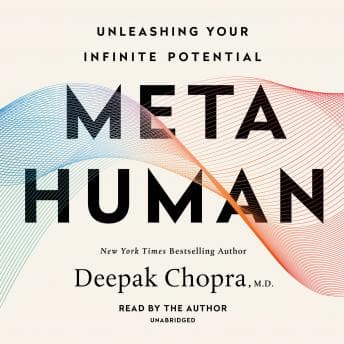
I picked this up during a particularly brutal week of grading undergrad papers—you know, the kind where every student thinks they've discovered Freud for the first time. I needed something to reset my brain. Something about expanding consciousness. "Metahuman" promises to help us break free from the constructs of the mind. And look, I'm a researcher. I study patterns. I know that breaking mental schemas is how growth happens. But getting through this audiobook was a test of patience I wasn't quite ready for.
When the Guru Drones On
Here's the raw data: Chopra narrates this himself. Usually, I'm a sucker for author-narrated books. When Brené Brown reads her work, you can hear the smile in her voice. You feel the vulnerability. It adds a layer of qualitative data you can't get from the text alone.
This isn't that.
Chopra sounds... careful. Painfully careful. He pronounces every single syllable with such precision that the rhythm of natural speech completely disintegrates. It's robotic. Monotone. I found myself checking the speed settings on my phone because I thought maybe I'd accidentally slowed it down. I hadn't.
Psychologically speaking, prosody (the rhythm and intonation of speech) is crucial for engagement. Without it, the brain stops paying attention to meaning and starts fixating on the sound. So instead of absorbing the secrets of the universe, I was lying on my yoga mat wondering why he says specific words that way. It creates this weird cognitive distance. The content is saying "wake up," but the delivery is whispering "go to sleep."
Breaking the Mental Construct (Or Trying To)
If you can get past the delivery—and that's a big if—the actual psychology here is fascinating. Chopra is arguing that what we consider "reality" is just a socially conditioned hallucination. In my field, we'd call this a radical deconstruction of the ego. He wants us to access "peak experiences" deliberately, rather than waiting for them to happen by accident.
If you're into that kind of systematic exploration of consciousness, Journey of Souls: Case Studies of Life Between Lives takes a similar case-study approach to what happens beyond our everyday awareness.
It's dense, though. This isn't the pop-psychology fluff you buy at the airport. It wanders. He goes on these long philosophical digressions that feel like a lecture from that one professor who refuses to use a syllabus. (We all know one. I might be one.)
But the 31-day guide at the end? That's the good stuff. It's practical. It gives you something to actually do. My therapist is always telling me to get out of my head and into my body, and the exercises here actually align with that. It's essentially a rigorous mindfulness bootcamp disguised as mysticism.
The Syllabus vs. The Lecture
Here's the bottom line: The material is heavy, complex, and potentially life-changing if you're open to it. But the medium matters. When I listen to something like Atomic Habits, the pacing drives the point home. Here, the pacing drags the point into a dark alley and leaves it there.
I ended up buying the physical book about halfway through. My brain just couldn't process the abstract concepts through the monotone audio delivery. I needed to see the words. I needed to underline them.
Who Should Listen (And Who Should Skip)
This one's for you if you're genuinely interested in the mechanics of consciousness and don't mind dense philosophical wandering. Skip the audiobook if flat narration makes your attention scatter—grab the print version instead. Or, honestly, if you're specifically using this to fall asleep? No judgment. It works.