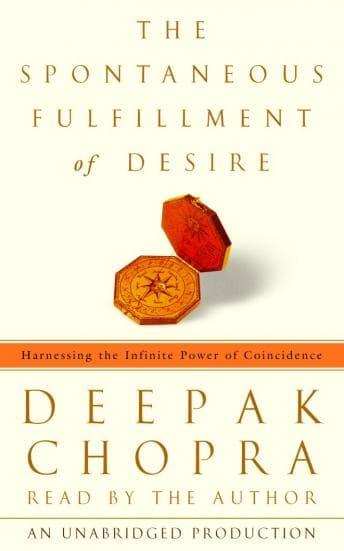

Look, I have a bone to pick with Deepak Chopra. Not about the content—we'll get there—but about the audacity of making me question my entire research methodology while I was supposed to be making dal.
There I was, stirring lentils at 10 PM (don't ask why I start cooking elaborate meals at night, my therapist has theories), when Chopra starts explaining how coincidences aren't random but rather glimpses into an infinite field of possibilities. And my academic brain immediately went: "Okay, but where's your control group?" This is my problem. I can't just receive spiritual wisdom. I have to interrogate it.
The Protagonist Exhibits Classic Confirmation Bias... Or Does He?
Here's what makes this audiobook a fascinating case study in belief systems: Chopra builds his entire framework on the premise that meaningful coincidences—what Jung called synchronicity—are actually access points to some underlying cosmic intelligence. The research shows that humans are pattern-recognition machines, often finding meaning where none exists. But Chopra anticipates this objection. He doesn't dismiss the skeptical perspective; he reframes it.
What makes his argument compelling is the practical exercises he includes. This isn't just philosophy floating in the ether. He gives you specific techniques—attention training, intention setting, meditation practices—that feel more like cognitive behavioral interventions than mystical handwaving. Motivation Myth takes a similar approach—stripping away the mystical and focusing on concrete behavioral systems. As a psychology researcher, I found myself asking: why does this work for so many people? Is it the placebo effect? Focused attention changing behavior? Or something my materialist framework can't accommodate?
I don't have answers. But I appreciate that he made me genuinely uncertain.
Chopra Reading Chopra: A Study in Calm Authority
There's something peculiar about authors narrating their own spiritual self-help books. Sometimes it's a disaster—ego bleeding through every syllable. But Chopra has this measured, almost clinical delivery that works surprisingly well. His voice is calm without being soporific, authoritative without being preachy. The real-world analogies land better hearing them in his cadence than they would from a hired voice actor trying to interpret his meaning.
That said, at six hours, the pacing requires dedicated attention. This isn't background listening material. I tried that—ended up burning my dal and missing an entire chapter on sutras. The concepts layer on each other. You need focus.
My one complaint: there's a certain repetitiveness to spiritual audiobooks that even Chopra can't escape. The core ideas get restated in slightly different language, which I understand is intentional (reinforcement, meditation, whatever), but my brain kept wanting him to move faster. I caught myself mentally editing: "Yes, yes, infinite possibilities, got it, what's next?"
Who Should Listen (And Who Should Run)
If you're a hardcore materialist who thinks anything with "consciousness" in the description is pseudoscience, you'll hate this. Just... don't. Save yourself the irritation.
But if you're in that weird liminal space—skeptical but curious, scientifically minded but aware that science doesn't explain everything about human experience—this is actually worth your time. Chopra isn't asking you to abandon critical thinking. He's asking you to expand what you pay attention to. The exercises are practical enough that you can test them empirically in your own life.
Also genuinely useful for anyone going through a period of feeling stuck or insignificant. (Given the state of the world, that's... most of us?) He reframes agency in a way that feels empowering without being toxic positivity. There's a psychological sophistication here that reminds me of Art of Seduction—both understand how humans construct meaning and how attention shapes reality, even if they apply that insight to very different ends.
My Clinical Assessment
Chopra understands human nature—specifically, our need for meaning and our capacity to shape experience through attention. Whether you attribute this to quantum fields or cognitive psychology is almost beside the point. The practical applications are sound.
Psychologically, this tracks better than most spiritual self-help. He grounds abstract concepts in actionable practices, which is where a lot of this genre fails. My therapist would probably approve of the meditation exercises, even if she'd raise an eyebrow at the metaphysics.
I finished the audiobook genuinely unsure whether I'd experienced something profound or been subjected to six hours of elegant confirmation bias. Which, honestly? Might be the highest compliment I can give a book in this genre. It made me think. It made me uncomfortable. It made me burn my dal.
That's more than most self-help can claim.