
Thirty hours. That's what I committed to while grading end-of-semester essays at 11 PM, and I'm not sure I've ever made a better decision while half-asleep and surrounded by papers about The Great Gatsby that clearly came from SparkNotes.
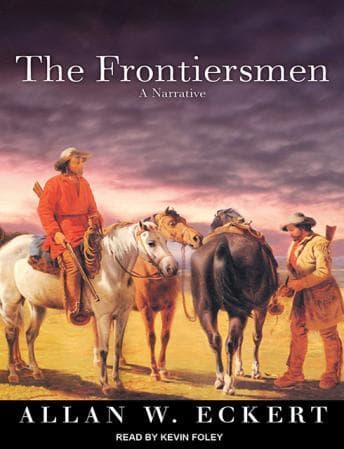
Allan W. Eckert does something here that I've been trying to explain to my American Lit students for two decades: history isn't a list of dates and battles. It's people making impossible choices in impossible circumstances. The Frontiersmen reads like a novel but carries the weight of primary sources—Eckert spent years in archives reconstructing dialogue from letters, journals, and court records. This is what Hemingway said about writing: "All you have to do is write one true sentence." Eckert writes thousands of them.
Two Protagonists, One Tragedy
The genius here is the dual narrative. Simon Kenton—this eighteen-year-old kid who fled Virginia thinking he'd killed a man in a fight over a girl—becomes the frontier's most capable scout. But Eckert gives equal weight to Tecumseh, and this is where the book becomes something more than frontier adventure. Watching Tecumseh's confederation rise and fall, understanding the strategic brilliance of his attempt to unite tribes from the Great Lakes to the Gulf—my students would hate this. I love it.
Kenton survives things that would kill most men twice over. Captured by Shawnee, he runs the gauntlet multiple times, gets beaten, burned, nearly executed. And yet Eckert never lets you forget that from the Shawnee perspective, Kenton and men like him were invaders destroying a civilization. The book doesn't moralize about this. It just shows you both sides until you're not sure who to root for anymore.
Kevin Foley Understands That Pause Is Punctuation
I listen at 1.0x because the author chose those words. Foley gets this. His narration is understated—no theatrical accents for every character, no vocal gymnastics. Instead, he uses subtle tone shifts that let you track who's speaking without pulling you out of the period. One listener said it felt like watching a movie, and I understand that comparison, but it's more accurate to say Foley narrates like a campfire storyteller who respects his material.
The pacing works for thirty hours because Foley never rushes the quiet moments. When Tecumseh speaks, there's weight to it. When violence erupts—and it does, frequently, brutally—Foley doesn't sensationalize. He lets Eckert's prose carry the horror. The descriptions of frontier warfare are not for the faint of heart. This is why we still read the classics, even when they're uncomfortable. Especially then.
The Commitment Problem (And Why It's Worth It)
Look, I'll be honest. Some listeners bounced off this because of the length and the narrative style. Eckert writes in a dense, detailed manner that requires attention. This isn't background listening while you pretend to pay attention at faculty meetings. (Principal Martinez, if you're reading this—I definitely wasn't listening to frontier history during the budget presentation. I was. It was worth it.)
The first few hours establish so many characters and locations that you might feel lost. Push through. By hour ten, you'll know the Ohio River Valley like your own neighborhood. By hour twenty, you'll care about people who died two centuries ago. That's the payoff for the commitment.
Who This Is For (And Who Should Walk Away)
If you loved Lonesome Dove, this is its spiritual predecessor—the same scope, the same moral complexity, the same refusal to simplify frontier life into heroes and villains. That same commitment to historical accuracy drives Killing Kennedy: The End of Camelot, though O'Reilly's approach is more straightforward narrative than Eckert's immersive reconstruction. If you're the kind of person who reads historical fiction and then falls down Wikipedia rabbit holes about the real people, Eckert has already done that research for you.
Skip this if you need constant action or if nuanced portrayals of violence disturb you. The frontier was brutal, and Eckert doesn't look away. Also skip if you can't handle long-form narrative history—there are no chapter breaks designed for easy stopping points.
Worth Pausing the Faculty Meeting For
Denise and I walked the lakefront for weeks with this in my ears. She asked why I kept stopping to stare at the water. I was thinking about Tecumseh's final stand at the Thames, about Simon Kenton living long enough to see everything he fought for become a different country than he imagined. The prose deserves to be savored.
Eckert wrote five more books in this series. I've already started the second. My grading pile grows. My students will survive. Some books are worth the late nights.






![Steve Jobs [unabridged audiobook] audiobook cover](/_next/image?url=https%3A%2F%2Fcovers.audiobooks.com%2Fimages%2Fcovers%2Ffull%2F9788499923406.jpg&w=1920&q=75)