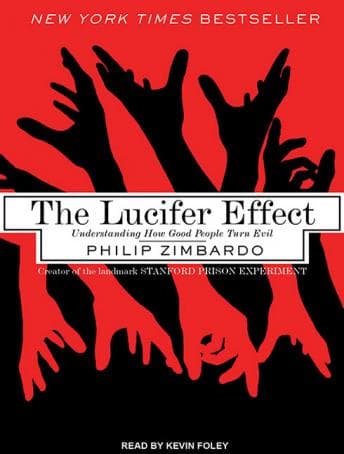

Okay, look. We need to talk about the sheer audacity of a twenty-seven-hour audiobook.
I listened to this over the course of three weeks of morning runs along the Charles River, and let me tell you—nothing kills a runner's high faster than realizing you, yes you, would probably torture someone if the lighting was bad enough and a guy in a lab coat told you it was okay.
(My therapist says I deflect with humor. She's not wrong.)
But seriously. I picked this up because, as a researcher, I'm obsessed with the "why." Why do people snap? Why do we hurt each other? We like to think evil is this separate thing—a serial killer, a monster, a "bad apple." But Zimbardo? He basically looks at us and says, "Nah. The barrel is rotten, and you're just fruit waiting to spoil."
When the Lab Coat Becomes the Costume
Here's the thing about the Stanford Prison Experiment. We study it in Psych 101. We critique it in grad school. (Methodologically? It's a mess. Don't get me started on the demand characteristics.) But hearing Zimbardo break it down day-by-day? It hits different.
It's less of a science lecture and more of a horror story where the villain is... situational dynamics.
The way he describes these normal college kids turning into sadists—or emotional wrecks—in less than a week is terrifying. It's not about them being secretly evil. It's about the permission structure. As someone who analyzes fictional characters for a living (well, for a hobby that I pretend is work), the character arcs here are too fast. If I read this in a novel, I'd say, "Unrealistic pacing."
But it's real. And that's the problem.
Zimbardo connects the dots from his basement mock-prison to Abu Ghraib, and honestly? It tracks. It's uncomfortable, it's messy, and it makes you look at your own moral compass and wonder if it's actually magnetic or just stuck.
Kevin Foley: Grandfatherly Professor Energy
If you want a narrator who sounds like the professor you wish you had—the one who gives you an extension on your paper because you look tired—Foley is your guy. His voice is deep, gentle, and incredibly clear.
But for twenty-seven hours?
I'm gonna be real with you—I had to crank this up to 1.5x speed. Maybe even 1.75x during the dense parts. Foley has this very deliberate, rhythmic delivery that is soothing, but when Zimbardo is describing psychological torture, the "soothing" vibe feels a little dissonant. Almost too calm.
Some listeners might find it monotonous. I didn't hate it, but it definitely lacks the urgency that the subject matter screams for. It's a lecture hall performance, not a theater stage. If you're used to high-octane true crime narrators who gasp at every twist, Foley is going to feel like a sedative.
Who This Is (and Isn't) For
If you're fascinated by the psychology of power, institutional corruption, or why ordinary people commit atrocities—this is essential listening. Skip it if you need fast pacing or can't stomach academic self-justification; Zimbardo has an ego (academics with egos? Shocking, I know) and inserts himself into the narrative a lot, sometimes in ways that feel like he's trying to absolve himself of the trauma he caused those students.
The Uncomfortable Takeaway
Is this book perfect? No. But the core message—that the line between good and evil is permeable—is something everyone needs to hear. Especially now. We love to think we're the heroes of our own stories. This book is a twenty-seven-hour reminder that, given the right circumstances, we might actually be the villains. Hot Zone gave me that same gut-punch realization—that we're all just one bad system away from catastrophe.
So, yeah. Listen to it. Just maybe do it in chunks. And definitely use the speed button. Your brain (and your patience) will thank you.